

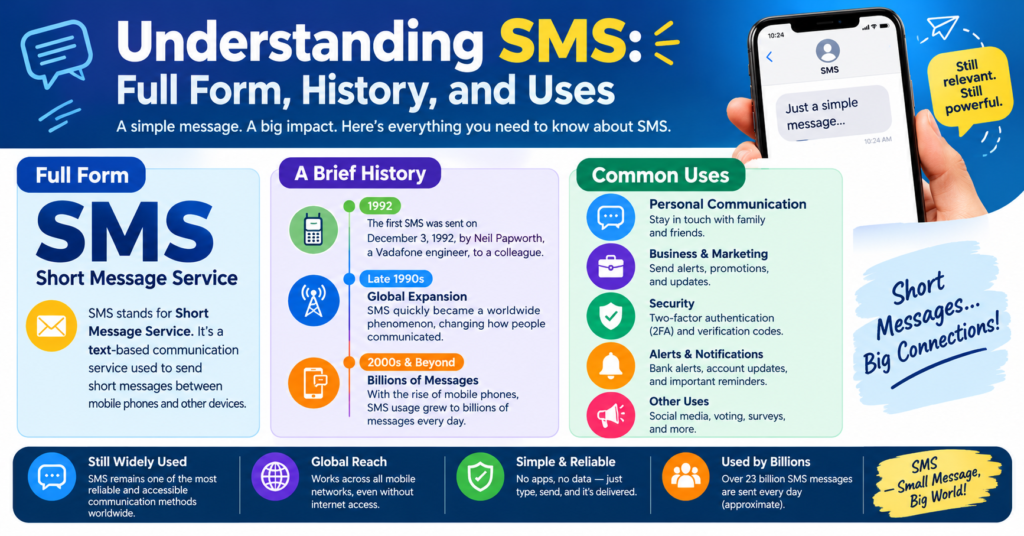
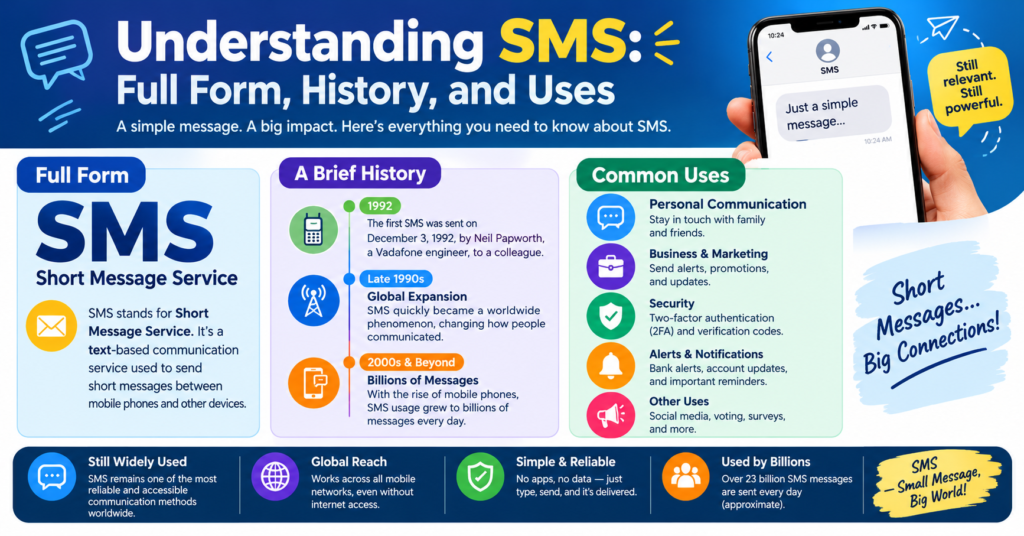
Have you ever wondered what SMS actually stands for? It’s a term we use every day without thinking twice. SMS stands for Short Message Service. It’s the technology behind every basic text message you send.SMS has been around for over 30 years now. It started as a simple way to send short notes between phones. Over time, it became one of the most used forms of communication. Today, billions of texts are sent through SMS daily.SMS is still useful even with newer messaging apps around. It works on every phone, even without internet access. Businesses use it for alerts, codes, and reminders. This guide covers its full form, history, and everyday uses.
What Does SMS Stand For?
SMS stands for Short Message Service. It’s a text-based communication protocol that lets one mobile device send a short message to another over a cellular network. Unlike apps that need Wi-Fi or mobile data, SMS travels over the same signaling channels that carry phone calls. That’s why it works even in areas with weak internet coverage, as long as there’s cell signal.
A few quick facts about the term:
- SMS is a protocol, not an app — it’s built into the mobile network itself
- It works on basic phones, smartphones, and even some computers
- It’s supported by every major carrier and network type worldwide
- The service doesn’t require an internet connection to function
How Does SMS Work?
SMS messages don’t travel directly from one phone to another. Instead, they pass through a few steps behind the scenes before reaching the recipient.
Here’s a simplified breakdown of the process:
- Encoding: Your message is converted into a compact digital format on your phone.
- Transmission to the tower: Your phone sends the encoded message to the nearest cell tower.
- SMS center routing: The tower forwards the message to a Short Message Service Center (SMSC), which acts as a relay hub.
- Delivery attempt: The SMSC locates the recipient’s phone on the network and forwards the message to it.
- Store and retry: If the recipient’s phone is off or out of range, the SMSC stores the message and retries delivery later.
This entire process usually takes just a few seconds. Because SMS relies on existing voice-network infrastructure, it doesn’t need a data plan or Wi-Fi connection to work, which is part of why it remains so reliable.
SMS vs. MMS: What’s the Difference?
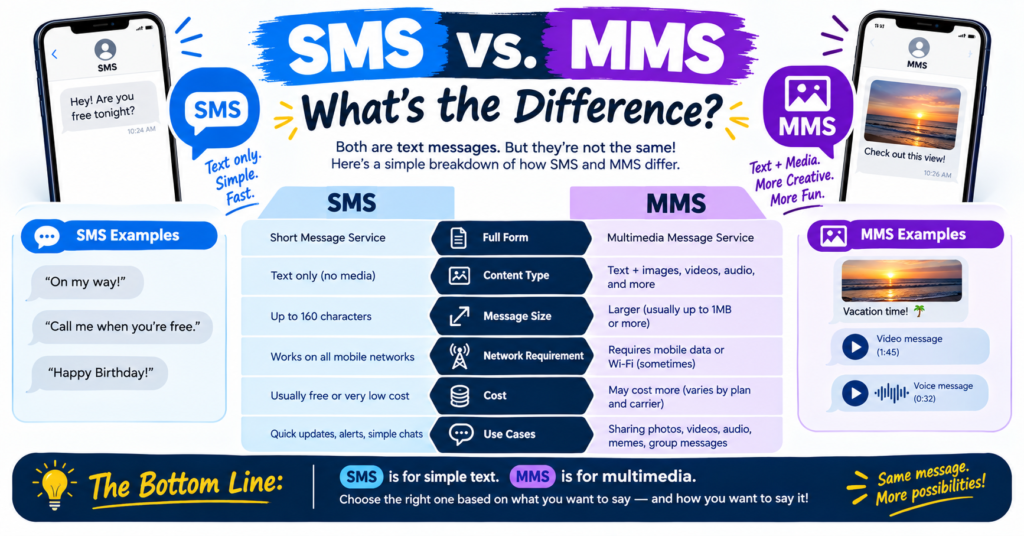
SMS and MMS are often mentioned together, but they’re not the same thing. The key difference comes down to what kind of content each one can carry.
| Feature | SMS | MMS |
|---|---|---|
| Full Form | Short Message Service | Multimedia Messaging Service |
| Content Type | Plain text only | Text, images, audio, video, GIFs |
| Character Limit | 160 characters | Up to 1,600 characters |
| Data Required | No internet needed | Often requires mobile data |
| Cost | Generally cheaper | Usually more expensive |
| Device Support | Works on nearly all phones | Requires multimedia-capable devices |
In short, every MMS is a type of text message, but not every text message is an MMS. If you send a photo or video in a text thread, your phone automatically switches from SMS to MMS to carry that content.
SMS vs. Instant Messaging Apps (WhatsApp, iMessage)
Instant messaging apps like WhatsApp and iMessage have changed how most people text, but SMS hasn’t disappeared. Each system works differently under the hood.
Key differences:
- Connection type: SMS uses the cellular network; messaging apps use internet data or Wi-Fi.
- Cross-platform delivery: SMS works between any two phones, regardless of brand or app. Messaging apps usually require both people to use the same platform.
- Fallback behavior: iMessage automatically switches to SMS when messaging a non-Apple device or when there’s no internet connection.
- Features: Apps like WhatsApp offer read receipts, group chats, voice notes, and end-to-end encryption, while standard SMS keeps things simple and text-based.
- Reliability in low-signal areas: SMS often gets through in places where data connections are weak or unavailable.
This is exactly why SMS still matters today. It acts as a universal fallback that guarantees message delivery, even when apps or internet connections fail.
History and Origin of SMS
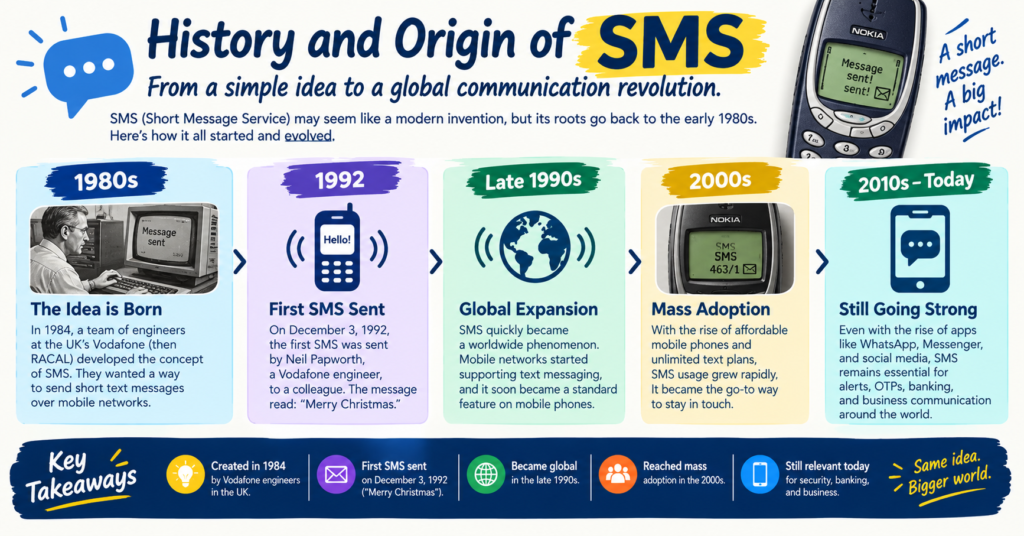
The idea behind SMS goes back to the early 1980s, long before smartphones existed. In December 1982, a plan was approved to add basic text messaging capability to the emerging GSM mobile network standard.The concept was developed further in 1984 by engineers Friedhelm Hillebrand and Bernard Ghillebaert. While studying typical sentence lengths, they determined that most short messages could fit within 160 characters, and that limit became the foundation of SMS as we know it.
Here’s a quick timeline of major SMS milestones:
| Year | Milestone |
|---|---|
| 1982 | GSM standard approved with support for text messaging |
| 1984 | 160-character limit established by Hillebrand and Ghillebaert |
| 1992 | First SMS text message sent in the UK, reading “Merry Christmas” |
| Early 2000s | SMS usage grows rapidly worldwide with cheaper mobile plans |
| 2010s | Instant messaging apps rise, but SMS remains a universal fallback |
SMS quietly became one of the most widely adopted communication technologies in history, largely because it worked on every device without needing extra software.
Common Uses of SMS Today
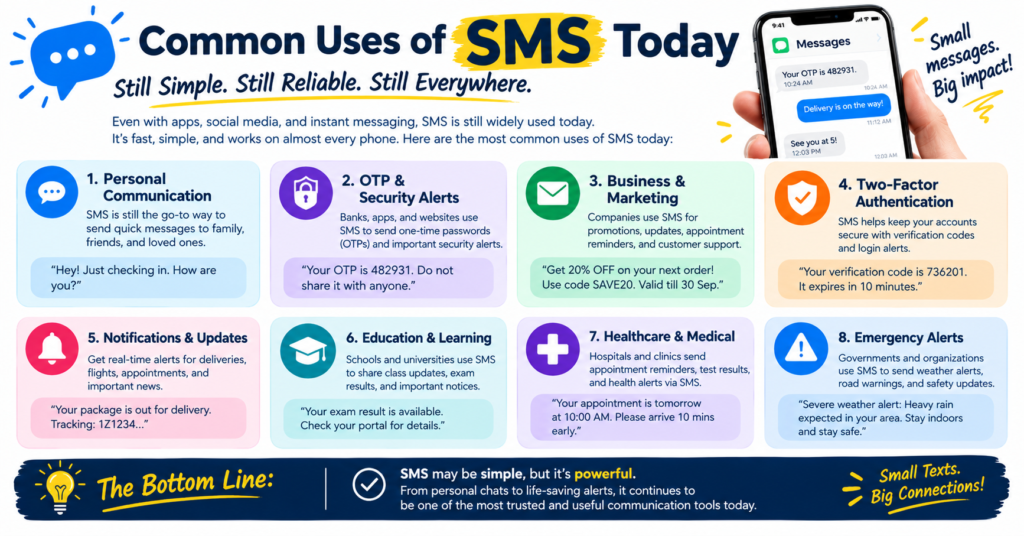
Even with countless messaging apps available, SMS remains a core communication tool for both individuals and businesses. Its simplicity and universal reach keep it relevant.
Common everyday and business uses include:
- Personal texting between friends and family, especially across different phone brands
- One-time passwords (OTPs) and two-factor authentication codes for account security
- Appointment reminders from doctors, salons, and service providers
- Delivery and order updates from online retailers and courier services
- Marketing and promotional messages sent by businesses to customers
- Emergency alerts from government agencies and weather services
Because SMS doesn’t rely on an app being installed or an internet connection being active, it remains one of the most dependable ways to reach someone instantly.
Character Limits and Costs of SMS
SMS messages are limited to 160 characters when using standard GSM 7-bit encoding. This limit exists because of how the original protocol was designed to fit within the signaling channel of mobile networks.
A few important details about limits and pricing:
- If a message uses special characters, emojis, or certain scripts, the limit often drops to 70 characters because a different encoding format is required.
- Longer messages are usually split into multiple linked SMS segments and reassembled on the recipient’s phone.
- Costs vary by carrier and plan. Many mobile plans now include unlimited SMS, while some regions still charge per message.
- Businesses sending bulk SMS (for marketing or alerts) typically pay per message through SMS gateway providers.
Compared to MMS or data-based messaging apps, standard SMS remains one of the most affordable and predictable ways to send a message.
Frequently Asked Questions
What does SMS stand for?
SMS stands for Short Message Service, a text messaging protocol used on mobile networks.
How many characters can an SMS contain?
A standard SMS allows up to 160 characters using basic text encoding, or 70 characters if special characters or emojis are used.
Is SMS the same as texting?
Texting is the general activity of sending messages, while SMS is the specific technology used to send basic text-only messages.
Does SMS need the internet to work?
No. SMS works over the cellular network’s signaling channel and doesn’t require Wi-Fi or mobile data.
What’s the difference between SMS and MMS?
SMS supports plain text only, while MMS supports text along with images, audio, and video.
Conclusion
SMS, or Short Message Service, has remained a dependable part of mobile communication for over three decades. From its origins in the early 1980s to its role in today’s OTP codes, reminders, and business alerts, SMS continues to work quietly in the background of daily life. While newer apps offer richer features, SMS’s simplicity, universal compatibility, and independence from the internet are exactly why it’s still relevant, and likely will be for years to come.
