

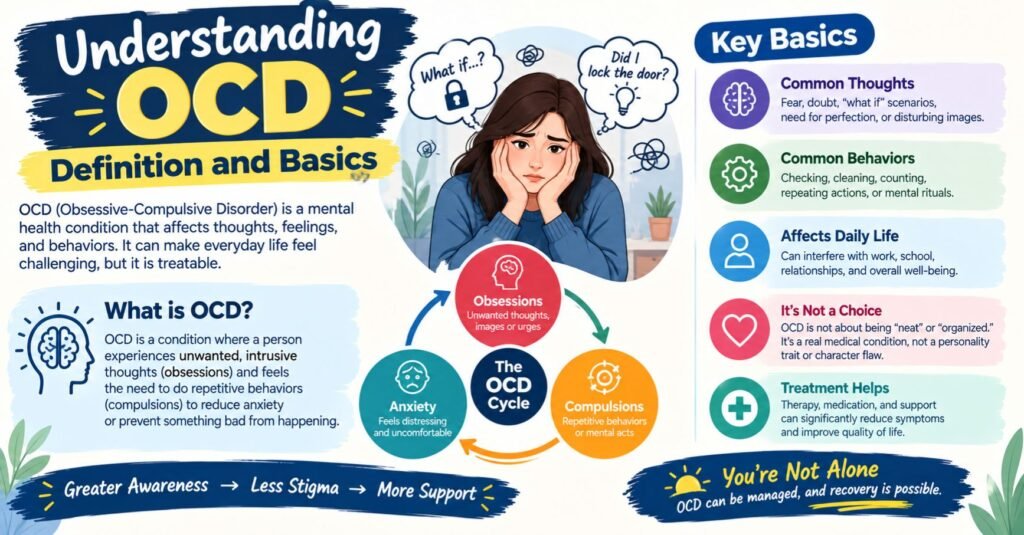
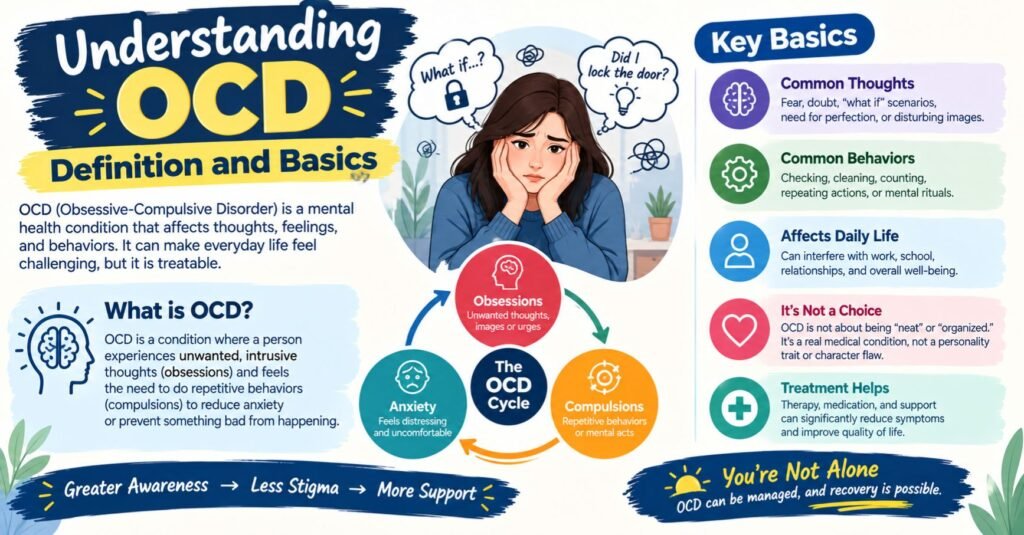
Have you heard someone say I’m so OCD about being neat or organized? The real meaning is very different. OCD stands for Obsessive-Compulsive Disorder. It’s a genuine mental health condition, not just a personality trait. OCD involves two main parts working together. The first is obsessions, which are unwanted thoughts that keep coming back. The second is compulsions, repeated actions done to ease that discomfort. Together, they can affect daily life in a big way. This condition is more common than most people realize. It can show up in many different forms and severities. Understanding what OCD really means helps reduce stigma around it. This guide breaks down the basics in simple, clear terms.
What Does OCD Stand For?
OCD stands for Obsessive-Compulsive Disorder. It’s a long-lasting mental health condition where a person experiences unwanted, recurring thoughts, repetitive behaviors, or both. These symptoms aren’t just quirks or preferences. They’re time-consuming and often cause real distress. For many people, OCD symptoms take up more than an hour a day and get in the way of work, school, or relationships. OCD affects people of all ages, backgrounds, and walks of life. Most cases are diagnosed by around age 19, though it can appear earlier in childhood or later in adulthood. It’s classified as a recognized psychiatric condition, not a lifestyle trait.
Common Symptoms of OCD
OCD symptoms generally fall into two categories: obsessions and compulsions. Not everyone experiences both in the same way, and symptoms can range from mild to severe.
Common obsessions include
- Fear of germs, contamination, or illness
- Unwanted thoughts about harm coming to yourself or others
- A need for symmetry, order, or exactness
- Intrusive thoughts that feel disturbing or wrong to the person having them
Common compulsions include
- Excessive hand. washing or cleaning
- Repeatedly checking locks, appliances, or switches
- Counting, tapping, or repeating actions a set number of times
- Arranging objects until they feel just right
- Seeking constant reassurance from others
These behaviors are usually performed to reduce anxiety caused by the obsessive thought. The relief is almost always temporary, which is part of why the cycle repeats.
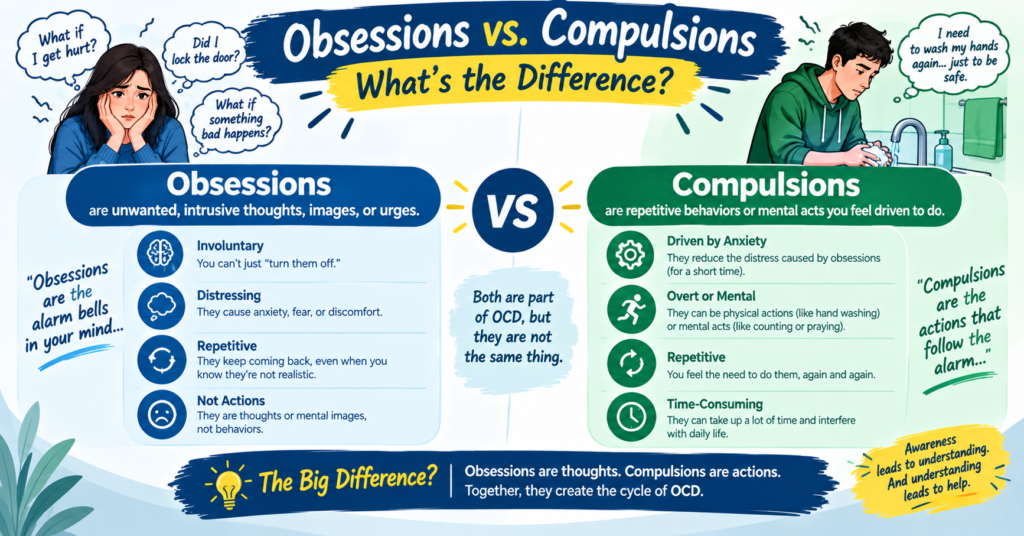
Obsessions vs Compulsions What’s the Difference?
Obsessions and compulsions work together, but they aren’t the same thing. Understanding the difference makes the disorder much easier to picture.
| Feature | Obsessions | Compulsions |
|---|---|---|
| What They Are | Intrusive, unwanted thoughts, images, or urges | Repetitive behaviors or mental acts |
| Purpose | Cause anxiety or distress | Attempt to reduce that anxiety |
| Example | Fear of contamination | Repeated hand-washing |
| Felt As | Involuntary and distressing | A “need” to perform, often ritualistic |
In simple terms, obsessions are the unwanted thought, and compulsions are the response to that thought. The two feed into each other, creating a repeating cycle that can be hard to break without treatment.
What Causes OCD?
There’s no single known cause of OCD. Researchers believe it develops from a combination of genetic, biological, and environmental factors working together.
- Genetics Having a parent or sibling with OCD is linked to a higher chance of developing it, though no single OCD gene has been identified.
- Brain structure and function Brain imaging studies show differences in specific brain circuits that help control behavior, fear, and habit formation.
- Neurotransmitters Imbalances in brain chemicals like serotonin are thought to play a role in OCD symptoms.
- Childhood temperament Anxious or cautious behavior patterns in early childhood may increase the likelihood of developing OCD later on.
- Environmental factors Stressful life events or, in some cases, childhood trauma may contribute to earlier or more severe symptoms.
Research into the exact causes is still ongoing. Most experts agree that OCD results from a mix of factors rather than one single trigger.
Is OCD the Same as Being a Perfectionist?
No, OCD and perfectionism are not the same thing, even though the terms often get mixed up in everyday conversation. Perfectionism is a personality trait tied to high standards and a preference for order.
OCD is different in a few key ways:
- Distress level: OCD causes significant anxiety and discomfort, not just a preference for things being right.
- Control: Obsessions feel intrusive and hard to control, unlike a general desire for neatness.
- Impact on life: OCD symptoms are time-consuming and can disrupt daily functioning, work, and relationships.
- Compulsions: Perfectionism doesn’t typically involve repetitive rituals performed to relieve anxiety.
Someone who likes an organized desk isn’t necessarily showing signs of OCD. The disorder involves a specific cycle of intrusive thoughts and distress-driven behaviors, not simply a preference for tidiness.
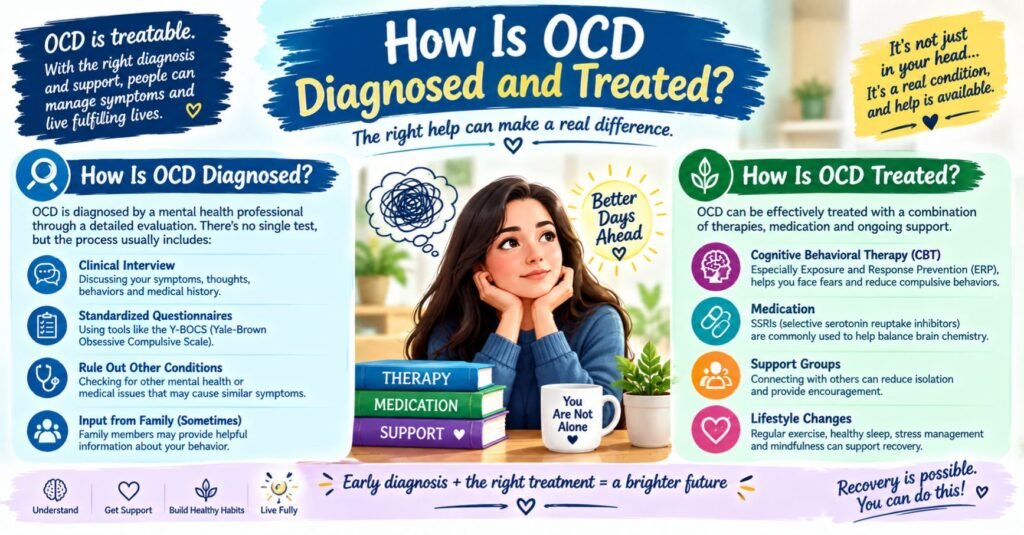
How Is OCD Diagnosed and Treated?
OCD is diagnosed by a mental health professional, such as a psychiatrist or psychologist, based on a clinical evaluation. There’s no lab test for OCD diagnosis relies on discussing symptoms, their frequency, and how much they interfere with daily life.
Professionals sometimes use structured tools, like the Yale. Brown Obsessive Compulsive Scale (Y. BOCS), to help measure symptom severity and track progress over time.
Common treatment options include:
- Exposure and Response Prevention (ERP): A specialized type of cognitive behavioral therapy that helps people face feared thoughts or situations without performing compulsions.
- Medication: Selective serotonin reuptake inhibitors (SSRIs) are commonly prescribed and FDA-approved for OCD treatment.
- Combination treatment: Many people respond best to a mix of therapy and medication together.
- Neuromodulation: For treatment-resistant cases, options like transcranial magnetic stimulation (TMS) may be considered.
Most people with OCD see meaningful improvement with treatment, though it can take time to find the right approach. Early diagnosis and consistent treatment generally lead to better outcomes.
Common Misconceptions About OCD
OCD is one of the most misunderstood mental health conditions, partly because of how casually the term gets used. Clearing up a few common myths helps build a more accurate picture.
- Myth: OCD just means being neat or organized. Liking things clean or orderly isn’t the same as having a diagnosed anxiety-driven disorder.
- Myth: People with OCD can just stop their compulsions. Compulsions are driven by genuine distress, not a simple choice, making them very difficult to stop without treatment.
- Myth: OCD only involves cleanliness or germs. OCD can center on many different themes, including harm, symmetry, relationships, or intrusive taboo thoughts.
- Myth: OCD is rare. OCD affects people worldwide and is more common than many assume, though it often goes undiagnosed for years.
- Myth: OCD is easy to spot. Many compulsions happen internally, like mental checking or silent counting, making the disorder invisible to people around them.
Frequently Asked Questions About OCD
What does OCD stand for?
OCD stands for Obsessive-Compulsive Disorder, a mental health condition involving unwanted thoughts and repetitive behaviors.
What are the main symptoms of OCD?
The main symptoms are obsessions, which are intrusive thoughts, and compulsions, which are repetitive behaviors performed to ease the distress they cause.
What causes OCD?
OCD is believed to result from a combination of genetics, brain chemistry, and environmental factors, though no single cause has been identified.
Is OCD the same as liking things clean or organized?
No, OCD involves genuine distress and repetitive rituals, while liking cleanliness or order alone is simply a personal preference.
How is OCD treated?
OCD is commonly treated with a type of therapy called Exposure and Response Prevention, SSRIs, or a combination of both.
Can OCD be cured completely?
There’s no single cure, but most people see significant symptom improvement with consistent, evidence-based treatment.
Conclusion
OCD, or Obsessive-Compulsive Disorder, is a genuine mental health condition built around a repeating cycle of obsessions and compulsions. It’s far more complex than the casual, everyday use of the term suggests, and it can affect anyone regardless of age or background. Understanding the real meaning behind OCD, along with its symptoms, causes, and treatment options, helps reduce stigma and points people toward the right kind of support when they need it.
