

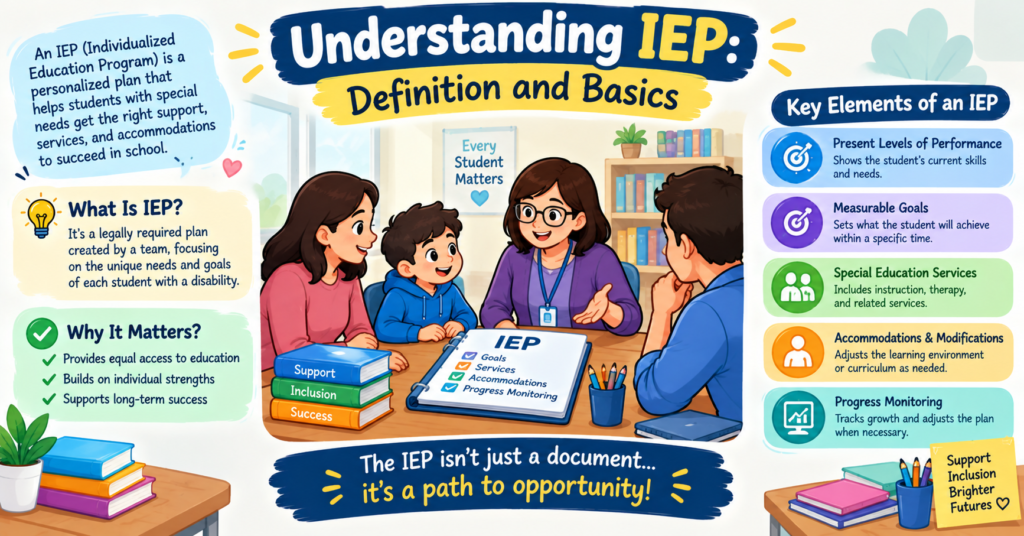
Have you heard the term IEP at your child’s school? It stands for Individualized Education Program. It’s a formal plan for students who need extra support. Schools create it to help kids learn in the best way possible. An IEP is built around one specific student. It lists their needs, goals, and the support they’ll receive. Teachers, parents, and specialists all work together on it. No two IEPs look exactly the same. This plan is protected under federal law in the U.S. It ensures students with disabilities get a fair education. Parents play a big role in shaping and approving it. This guide breaks down what an IEP really means.
What Does IEP Stand For?
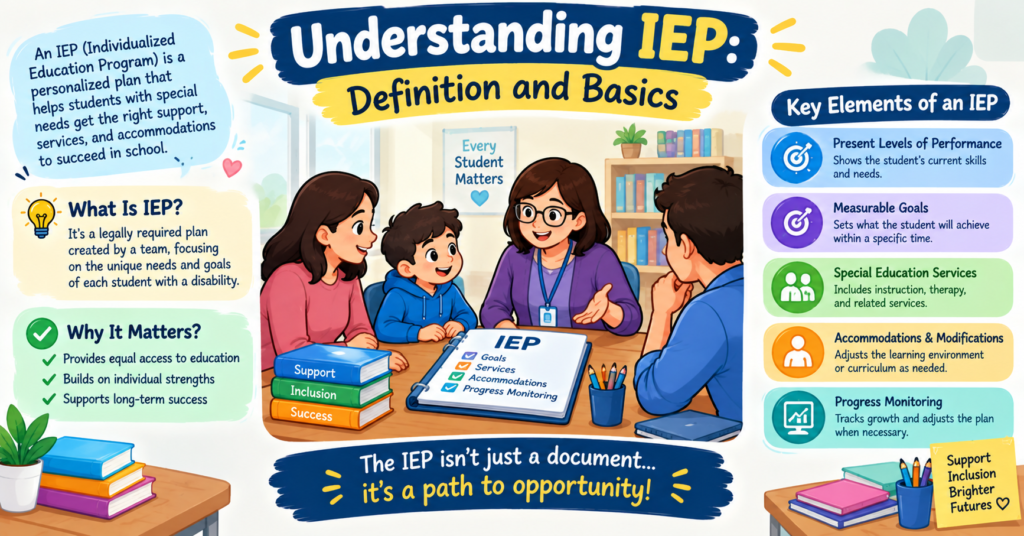
IEP stands for Individualized Education Program. It’s a legally binding, written plan created for a student who has a disability and needs specialized instruction to succeed in school. The IEP is required under a federal law called the Individuals with Disabilities Education Act (IDEA). This law guarantees eligible students a Free Appropriate Public Education (FAPE), delivered in the Least Restrictive Environment (LRE) possible, meaning alongside general education peers whenever it makes sense. An IEP isn’t a generic template. It’s built around one child’s specific strengths, needs, and goals, which is exactly why the word individualized sits right in the name.
Who Qualifies for an IEP?
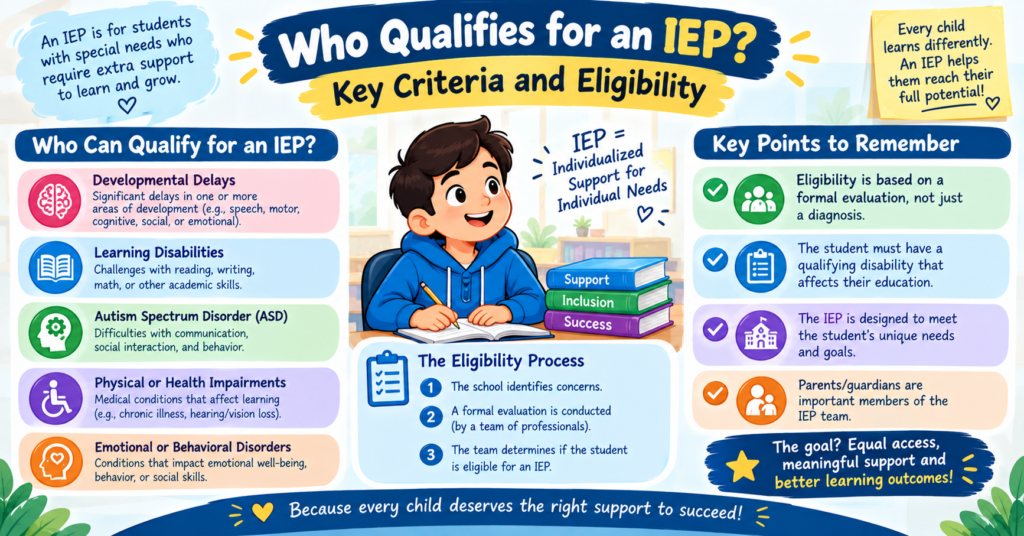
Not every student who struggles in school automatically qualifies for an IEP. Eligibility depends on meeting two specific conditions under IDEA.
A student generally qualifies when:
- They have a disability that falls under one of 13 disability categories recognized by IDEA, such as autism, specific learning disabilities, speech or language impairment, ADHD (under “other health impairment”), or emotional disturbance.
- That disability negatively affects their educational performance and creates a genuine need for specialized instruction, not just general support.
The process usually starts with a referral, which any parent, teacher, or school professional can request. From there, the school must respond in writing, typically within 10 to 15 school days depending on the state, before moving forward with a formal evaluation.
Simply having a diagnosis isn’t enough on its own. The disability must be shown to directly impact the student’s ability to learn and progress in the general education curriculum.
What’s Included in an IEP Document?
Federal regulations spell out exactly what an IEP must contain. Missing any of these required elements can be considered a procedural violation of the student’s rights.
A complete IEP document typically includes:
- Present levels of performance A summary of the student’s current academic and functional skills
- Measurable annual goals Specific, trackable goals the student is expected to work toward
- Special education and related services The exact supports provided, such as speech therapy or reading instruction
- Accommodations and modifications Adjustments like extra time, preferential seating, or assistive technology
- Participation in general education An explanation of how much time the student spends in general education settings
- Service details The frequency, location, and duration of each service provided
- Transition planning Required starting around age 14–16, focused on life after high school
- Progress reporting How and when parents will be updated on the student’s progress toward goals
Every one of these sections must be specific and measurable. A vague goal like “will improve reading” doesn’t meet IDEA’s standards — it needs a clear target, timeline, and way to measure progress.
IEP vs 504 Plan What’s the Difference?
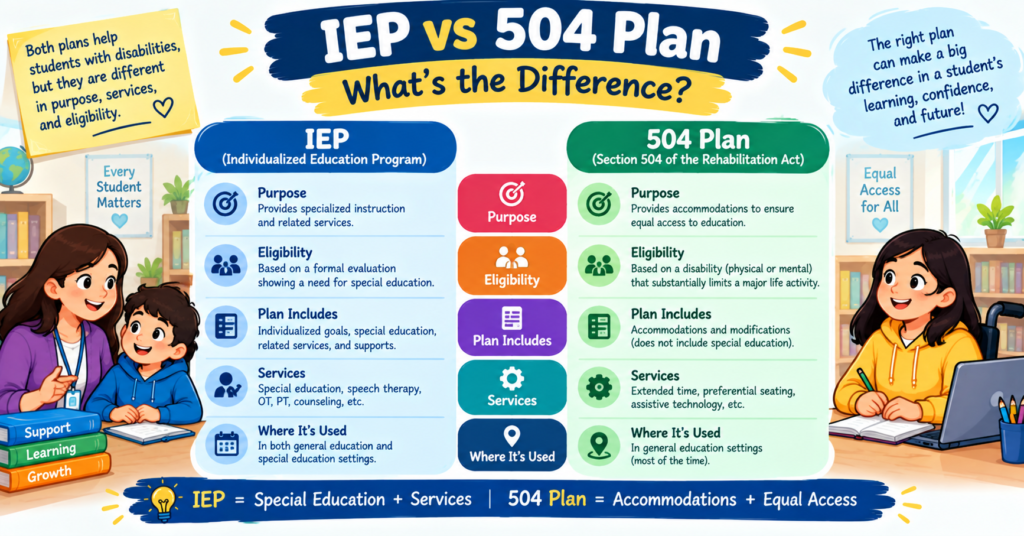
IEPs and 504 Plans both support students with disabilities, but they’re not the same thing. Confusing the two is one of the most common mistakes parents make.
| Feature | IEP | 504 Plan |
|---|---|---|
| Governing Law | IDEA (Individuals with Disabilities Education Act) | Section 504 of the Rehabilitation Act |
| What It Provides | Specialized instruction plus services | Accommodations only, no specialized instruction |
| Eligibility | Must fall under one of 13 IDEA disability categories | Any disability that limits a major life activity |
| Document Type | Detailed, legally binding education plan | Shorter plan focused on access and accommodations |
| Example | Speech therapy, reading intervention, behavior support | Extended test time, preferential seating |
In simple terms, an IEP provides specialized teaching designed around the student’s disability, while a 504 Plan removes barriers so a student can access the same general education curriculum as their peers. A student who needs direct instruction usually needs an IEP; a student who mainly needs access adjustments may only need a 504 Plan.
How Is an IEP Created and Reviewed?
Creating an IEP follows a structured process defined by federal law. It typically unfolds through the following steps.
- Referral A parent, teacher, or professional requests an evaluation.
- Consent and Evaluation The school gets written parental consent, then conducts a full evaluation across relevant areas.
- Eligibility Meeting A team reviews evaluation results to determine if the student qualifies under IDEA.
- IEP Meeting If eligible, a team meets to write the actual IEP document, including goals and services.
- Implementation The school puts the plan into action, with teachers and specialists following it directly.
- Annual Review The IEP is reviewed and updated at least once a year to reflect the student’s progress and needs.
- Re-evaluation A full re-evaluation typically happens at least once every three years.
The IEP team must include the parents, at least one general education teacher, at least one special education teacher, and a school district representative. Once the student turns 14, they’re generally invited to attend and take part in planning their own transition goals.
Parents’ Rights in the IEP Process
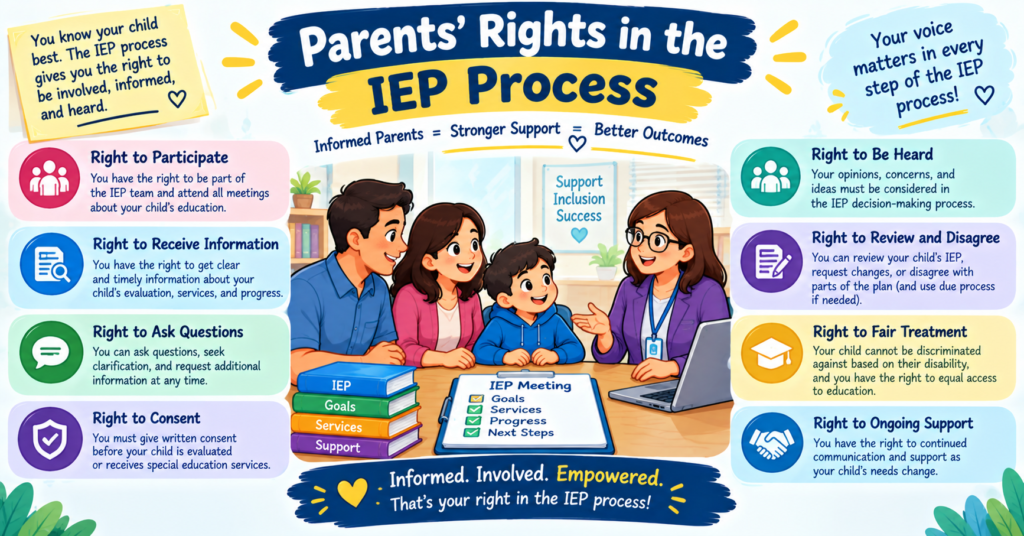
Parents aren’t just invited to IEP meetings they hold specific legal rights throughout the entire process under IDEA. Understanding these rights helps families advocate effectively for their child.
Key parental rights include:
- The right to participate in every IEP meeting as an equal member of the team
- The right to written notice before the school proposes or refuses to change a student’s evaluation, placement, or services
- The right to consent before the initial evaluation and before special education services begin
- The right to request an independent evaluation if they disagree with the school’s assessment
- The right to access records, including reviewing all educational and evaluation documents
- The right to dispute resolution, including mediation or a formal due process hearing if disagreements can’t be resolved
Schools are required to make a genuine effort to include parents in scheduling meetings at a mutually agreeable time. If a parent disagrees with part of the IEP, they can request changes, and in many cases, services outlined in a prior IEP continue while a dispute is being resolved.
Common Misconceptions About IEPs
IEPs are often misunderstood, even by families going through the process for the first time. Clearing up a few common myths can make the whole system feel less overwhelming.
- Myth: An IEP is the same for every student with a similar diagnosis. Two students with the same disability can have completely different IEPs, since the plan is based on individual needs, not the diagnosis alone.
- Myth: A diagnosis automatically means a student gets an IEP. Eligibility requires both a qualifying disability and proof that it affects the student’s educational performance.
- Myth: Once an IEP is written, it can’t be changed. IEPs are reviewed at least annually and can be updated any time the team agrees changes are needed.
- Myth: IEPs are only for students with severe disabilities. IEPs cover a wide range of needs, from mild learning disabilities to significant cognitive or physical disabilities.
- Myth: Schools have final say over the IEP. Parents are equal members of the IEP team and have the legal right to disagree with proposed decisions.
Frequently Asked Questions About IEP
What does IEP stand for?
IEP stands for Individualized Education Program, a legal plan for students who qualify for special education services.
Who decides if a child gets an IEP?
A team that includes parents, teachers, and school specialists reviews evaluation results together to decide eligibility.
What is the difference between an IEP and a 504 Plan?
An IEP provides specialized instruction and services, while a 504 Plan only provides accommodations to access the general curriculum.
How often is an IEP reviewed?
An IEP must be reviewed at least once a year, with a full re-evaluation typically required every three years.
Can a parent refuse or dispute an IEP?
Yes, parents can disagree with parts of an IEP and request mediation or a formal due process hearing to resolve disputes.
At what age does an IEP end?
An IEP generally continues until a student graduates high school or turns 21, depending on state law.
Conclusion
An IEP, or Individualized Education Program, is a legally protected plan designed to give students with disabilities the specialized instruction and support they need to succeed in school. From eligibility and required components to parents’ rights and the review process, understanding how IEPs work helps families advocate confidently for their child. Knowing the difference between an IEP and a 504 Plan, along with common misconceptions, makes the entire special education process much easier to navigate.
