

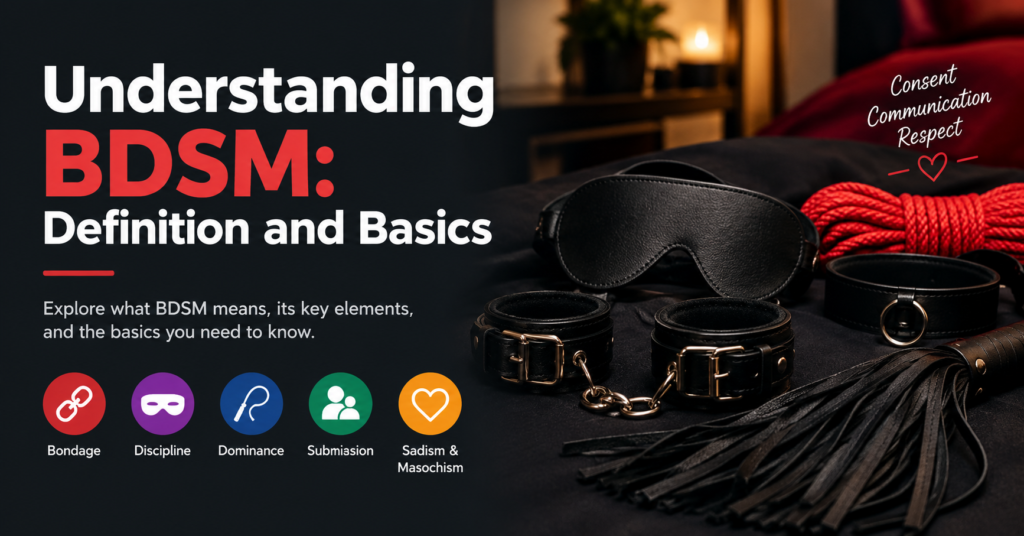
BDSM is a term used to describe a range of consensual practices between adults. It stands for Bondage and Discipline, Dominance and Submission, and Sadism and Masochism. These practices often involve power exchange, roleplay, or physical sensation. Many people know the term but don’t fully understand what it means .The concept covers a wide spectrum of activities and relationship dynamics. Some people are drawn to power exchange, where one partner leads and the other follows. Others focus more on physical sensation or the trust that builds between partners. Every couple or group defines their own boundaries. Safety and consent are at the core of BDSM practices. Clear communication between partners happens before any activity begins. Trust and mutual respect are considered essential parts of the experience. This guide breaks down the basics so you understand the meaning clearly.
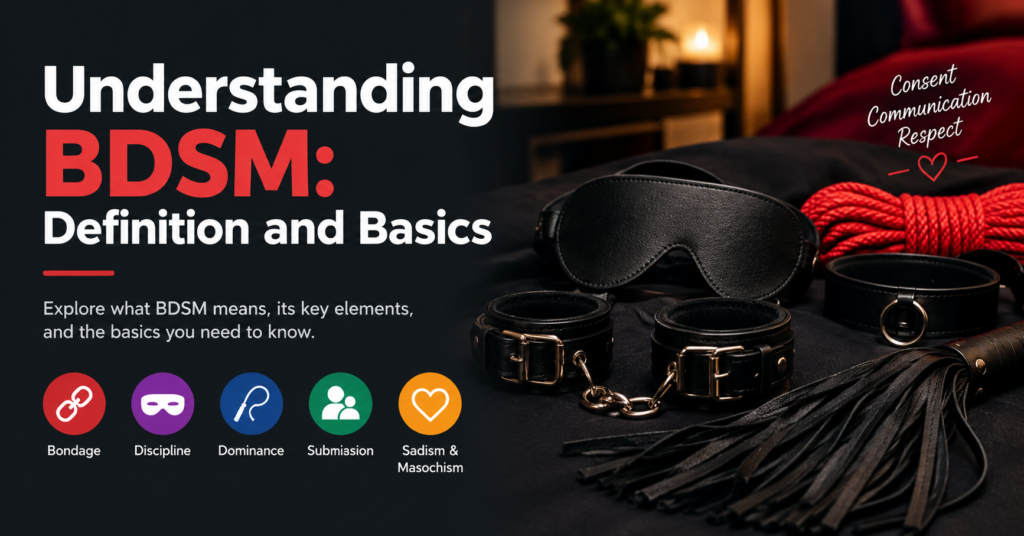
What Does BDSM Stand For?
BDSM is an acronym made up of three overlapping pairs of words. It combines Bondage and Discipline (B/D), Dominance and Submission (D/S), and Sadism and Masochism (S/M) into one term.
Each pair describes a different part of the overall concept:
- Bondage and Discipline (B/D): Physical restraint and structured rules between partners
- Dominance and Submission (D/S): A power dynamic where one partner leads and the other follows
- Sadism and Masochism (S/M): The consensual exchange of physical or psychological sensation
Dictionaries generally define BDSM as a set of sexual preferences and behaviors involving restraint, power exchange, or sensation, always framed around mutual agreement between adults. The term itself became widely used online in the early 1990s, though the ideas behind it existed long before that.
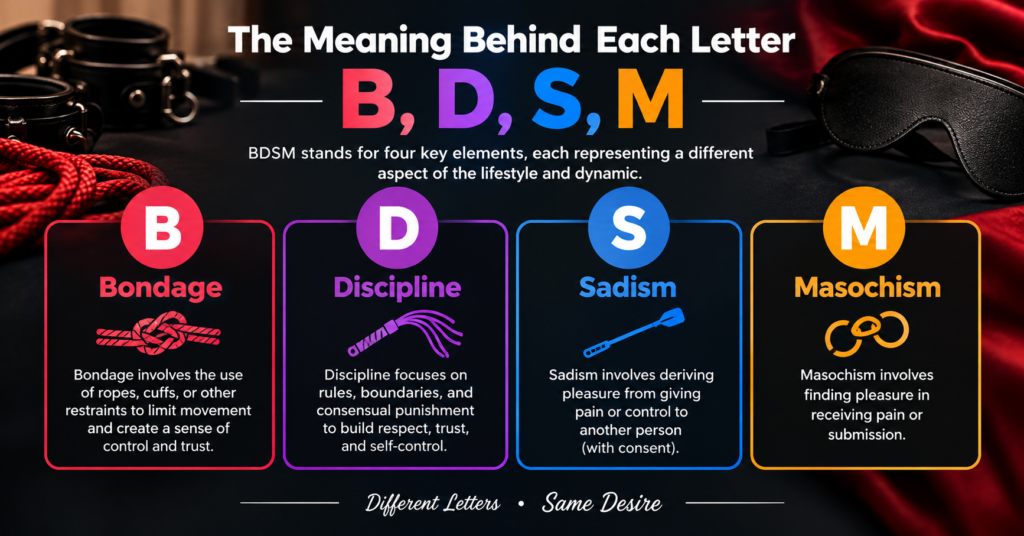
The Meaning Behind Each Letter (B, D, S, M)
Breaking BDSM down letter by letter makes the acronym much easier to understand. Here’s what each part represents.
| Letter | Stands For | What It Means |
|---|---|---|
| B | Bondage | Physical restraint used during a scene, often with rope, cuffs, or similar tools |
| D | Discipline / Dominance | Structured rules and consequences, or one partner taking a leading role |
| S | Submission / Sadism | Willingly yielding control, or finding pleasure in giving sensation |
| M | Masochism | Finding pleasure in receiving sensation, always by choice |
It helps to think of BDSM as three separate categories layered together rather than four unrelated letters. Someone might identify strongly with one category and have little interest in the others. There’s no single “right” combination — it depends entirely on the people involved.
Common Misconceptions About BDSM
BDSM is often misunderstood because of how it’s portrayed in movies, media, and casual conversation. Clearing up a few common myths helps put the concept into better context.
- Myth: BDSM is always about pain. Sensation play is only one part of BDSM. Many people focus more on trust, control, or roleplay than on physical intensity.
- Myth: It’s linked to abuse. Genuine BDSM is built entirely on consent. Abuse, by definition, lacks consent, which is the key difference between the two.
- Myth: People who enjoy BDSM have unresolved trauma. Research hasn’t found a consistent link between BDSM interest and past trauma. People engage in it for many reasons, including simple enjoyment and connection.
- Myth: It’s rare or unusual. Interest in kink and power-exchange dynamics is more common than most people assume, spanning many backgrounds and relationship types.
- Myth: BDSM requires special equipment or extreme scenarios. At its core, BDSM is about a dynamic between people. It can be as simple as a verbal power exchange with no props involved at all.
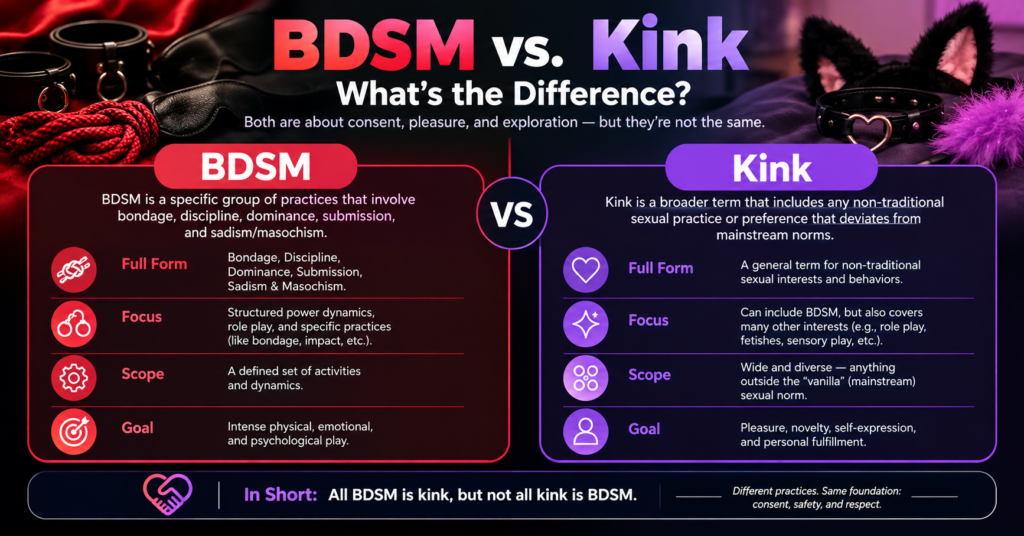
BDSM vs. Kink: What’s the Difference?
People often use “BDSM” and “kink” interchangeably, but they aren’t exactly the same thing. Understanding the difference helps clarify how the terms fit together.
| Term | Definition | Scope |
|---|---|---|
| BDSM | A specific acronym covering bondage, discipline, dominance, submission, sadism, and masochism | Narrower, describes specific practices |
| Kink | A broad term for any non-traditional sexual interest or preference | Wider, includes BDSM as one category among many |
In short, BDSM is a type of kink, but not all kinks fall under BDSM. Kink can include interests that have nothing to do with power exchange or restraint at all. BDSM is best thought of as one well-known branch under the much larger kink umbrella.
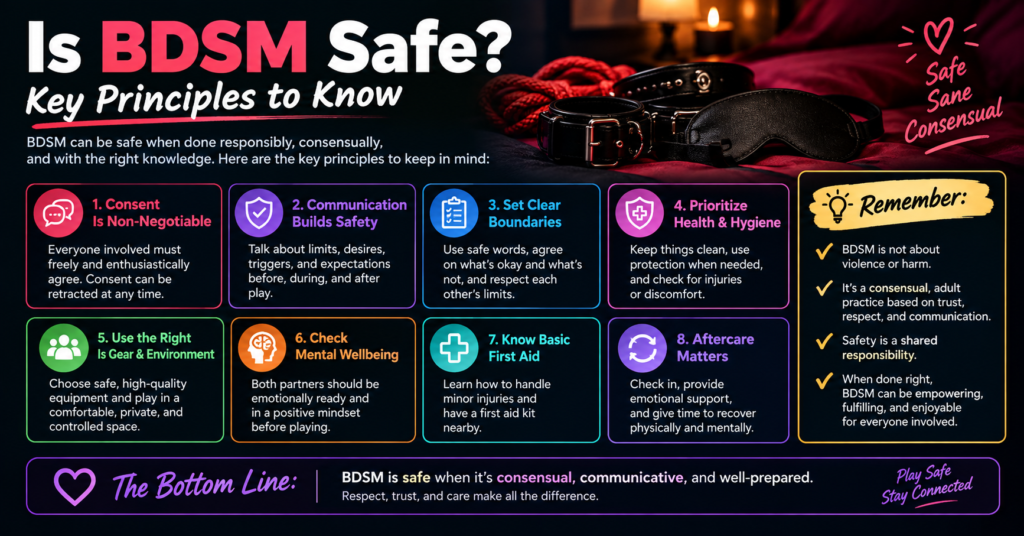
Is BDSM Safe? Key Principles to Know
Safety is one of the most important parts of BDSM, and the community has developed clear principles to keep practices consensual and respectful. Most experienced practitioners follow a shared set of guidelines.
- Consent: Every activity is agreed upon by everyone involved, before anything begins.
- Communication: Partners discuss boundaries, interests, and limits openly and honestly.
- Safe words: A simple word or signal lets anyone stop or pause an activity immediately.
- Aftercare: Time spent afterward to check in emotionally and physically with each other.
- Education: Learning proper techniques reduces physical risk, especially with restraint or sensation play.
Two common frameworks guide these principles:
- SSC (Safe, Sane, Consensual): Activities should be physically safe, done with a clear mind, and fully agreed upon.
- RACK (Risk-Aware Consensual Kink): Acknowledges that some risk is always present, and focuses on informed, accepted risk rather than eliminating it entirely.
Following these principles is what separates healthy BDSM practice from harm. Anyone new to the topic is generally encouraged to start slow, communicate constantly, and prioritize trust above all else.
History and Origin of the Term
The ideas behind BDSM go back much further than the acronym itself. Power exchange, restraint, and ritualized discipline appear in historical texts and cultural practices across many centuries.The term “BDSM” as we know it today is believed to have first appeared in an online Usenet discussion group in 1991. It was formed by blending three older abbreviations: B&D (Bondage and Discipline), D&S (Dominance and Submission), and S&M (Sadism and Masochism).Before the internet made the combined term common, “S&M” was the phrase most people used, dating back to the mid-20th century. As online communities grew through the 1990s and 2000s, BDSM became the standard umbrella term, allowing people to discuss the full range of related interests under one label rather than several separate ones.Today, BDSM is recognized in major dictionaries and widely discussed in relationship and sexuality education, reflecting how mainstream understanding of the term has grown over the past few decades.
Frequently Asked Questions
What does BDSM stand for?
BDSM stands for Bondage and Discipline, Dominance and Submission, and Sadism and Masochism.
Is BDSM the same as kink?
No. BDSM is one specific category of kink, while kink is a broader term covering many non-traditional interests.
Is BDSM considered safe?
Yes, when practiced with clear consent, communication, and safety principles like SSC or RACK, it’s considered a safe and consensual activity.
Where did the term BDSM come from?
The acronym is believed to have first appeared in a 1991 online discussion group, combining three earlier terms: B&D, D&S, and S&M.
Does BDSM always involve pain?
No. Many people focus on trust, control, or roleplay rather than physical sensation, so pain isn’t a requirement.
Conclusion
BDSM is a broad term describing consensual practices built around bondage, discipline, dominance, submission, sadism, and masochism. While the acronym can look intimidating at first, its foundation is simple: trust, consent, and open communication between the people involved. Understanding the meaning behind each letter, along with the key safety principles, makes it easier to see BDSM as a well-defined, consensual part of adult relationships rather than something mysterious or misunderstood.
