

TDS stands for Tax Deducted at Source. It is a system used to collect tax directly from the source of income. The government introduced this method to make tax collection easier. It also helps reduce tax evasion.Under this system, a certain amount of tax is cut before making a payment. This can happen on salary, rent, commission, or interest. The person or company making the payment deducts the tax. Then they deposit it with the government on your behalf.TDS ensures that tax is collected regularly throughout the year. It is not a separate tax, but a way of paying tax in advance. Later, this amount is adjusted against your total tax liability. Understanding TDS helps you manage your finances better.
What Is TDS and Why Is It Important?
If you’ve ever checked your salary slip or an FD interest credit and noticed the amount was slightly less than expected, you’ve already encountered TDS. Tax Deducted at Source (TDS) is one of the most common — and most misunderstood — parts of the Indian tax system.This guide breaks down what TDS means, how it actually works, current deduction rates, how to check your TDS online, and the difference between Form 16 and Form 16A — in plain, simple language.TDS matters because it keeps tax collection steady throughout the year instead of piling up as one lump-sum payment. It also gives the government real-time visibility into high-value transactions and helps taxpayers avoid a large tax bill at filing time.
TDS Meaning in Different Contexts
TDS full form is Tax Deducted at Source. At its core, it’s a system where the person or entity making a payment deducts a fixed percentage of tax before paying the recipient, and deposits that amount with the government.
While the core idea stays the same, TDS shows up differently depending on the type of transaction:
- Salary TDS — deducted by an employer based on the employee’s applicable tax slab
- Interest TDS — deducted by banks on fixed deposit or savings interest above a threshold
- Rent TDS — deducted by tenants paying rent above a specified monthly limit
- Professional fee TDS — deducted by businesses paying consultants, freelancers, or contractors
- Property TDS — deducted by buyers on high-value property transactions
In every case, the same principle applies: tax is collected upfront, before the money reaches the recipient’s hands.
TDS Meaning in Income Tax
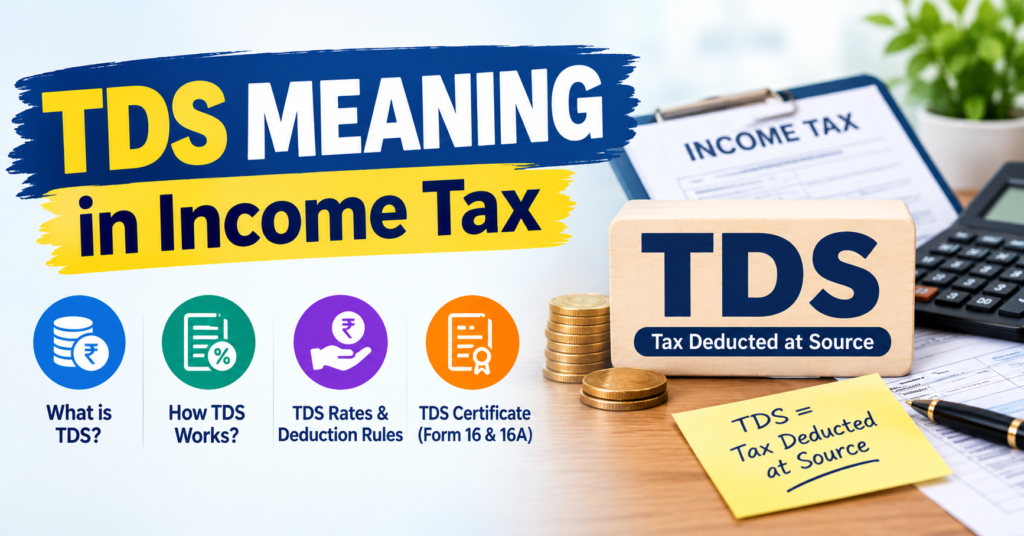
In income tax law, TDS is treated as a form of advance tax. Instead of waiting for the taxpayer to calculate and pay tax at year-end, the government collects a portion of it the moment income is paid or credited.Two key parties are involved:
| Term | Meaning |
|---|---|
| Deductor | The person or entity making the payment and deducting TDS |
| Deductee | The person receiving the payment, whose tax gets deducted |
The deductee doesn’t lose this money — it’s credited against their Permanent Account Number (PAN) and can be claimed while filing an Income Tax Return (ITR). If the total TDS deducted during the year is higher than the actual tax liability, the taxpayer is entitled to a refund.
How Does TDS Work?
TDS follows a simple, repeatable cycle every time an eligible payment is made:
- Identify the payment type — the deductor checks whether the payment (salary, rent, interest, etc.) is covered under TDS provisions.
- Check the threshold and rate — if the payment crosses the specified limit, TDS applies at the prescribed rate.
- Verify PAN details — the deductor confirms the recipient’s PAN before deduction. Without a valid PAN, TDS is deducted at a higher rate (usually 20%).
- Deduct and pay — the deductor withholds the TDS amount and pays the remaining balance to the recipient.
- Deposit with the government — the deducted amount is deposited with the Central Government, typically by the 7th of the following month.
- File a TDS return and issue a certificate — the deductor files a quarterly TDS return and issues Form 16 or Form 16A to the deductee.
Example
A company pays ₹1,00,000 to a consultant for professional services. Since this exceeds the applicable threshold, TDS is deducted at 10%. The company pays ₹90,000 to the consultant and deposits the remaining ₹10,000 with the government on their behalf.
TDS Deduction Rules and Rates
TDS rates vary depending on the nature of the payment, the amount involved, and whether the recipient is a resident or non-resident. Here’s a quick snapshot of commonly applicable rates:
| Payment Type | Threshold (Approx.) | TDS Rate |
|---|---|---|
| Salary | As per income slab | Slab rate |
| Bank FD/Interest (non-senior) | ₹50,000/year | 10% |
| Bank FD/Interest (senior citizen) | ₹1,00,000/year | 10% |
| Rent (individuals/HUF, Sec 194-IB) | ₹50,000/month | 2% |
| Rent (others, Sec 194-I) | ₹6,00,000/year | 10% (land/building), 2% (plant/machinery) |
| Professional/Technical Fees | ₹50,000/year | 10% |
| Contractor Payments | Varies | 1%–2% |
| Dividend | ₹5,000/year | 10% |
| Lottery/Game Winnings | Any amount | 30% |
| No PAN Provided | — | 20% (flat) |
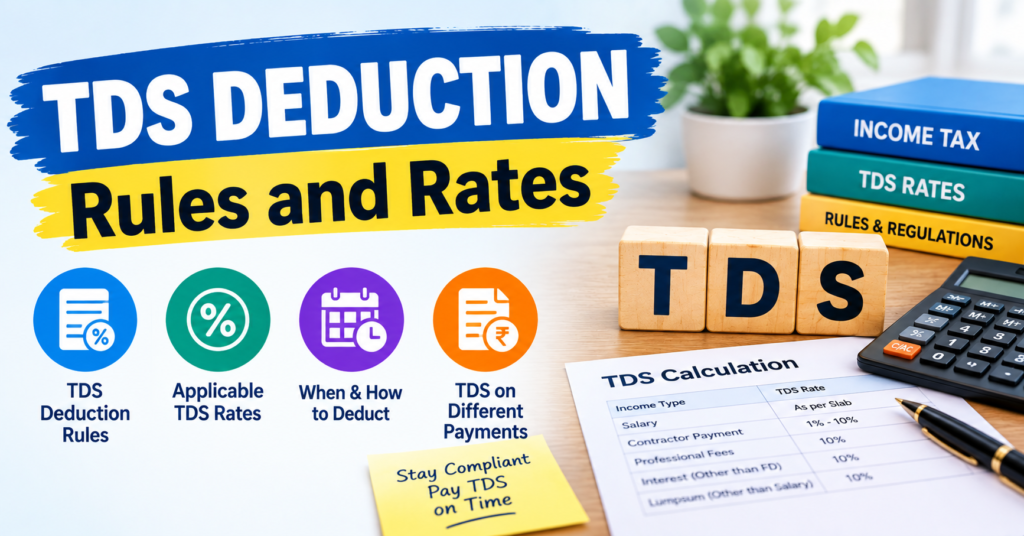
Key rules to remember:
- TDS must be deducted at the time of payment or credit, whichever is earlier.
- If a taxpayer’s income is below the taxable limit, they can avoid TDS on interest by submitting Form 15G (below 60 years) or Form 15H (senior citizens) to the bank.
- Failure to deduct or deposit TDS on time attracts interest, late filing fees, and in some cases, disallowance of the related expense.
- From FY 2026–27, most non-salary TDS provisions have been consolidated under the Income-tax Act, 2025, replacing several older sections with a single unified rate table.
How to Check TDS Details Online
Checking your TDS status is simple and can be done in a few steps:
- Visit the Income Tax e-filing portal or the TRACES portal.
- Log in using your PAN and registered credentials.
- Navigate to Form 26AS (or Annual Information Statement/AIS).
- Select the relevant assessment year.
- View the TDS deducted, deposited, and reported against your PAN.
Why This Matters
Form 26AS acts as a consolidated statement showing all TDS deducted on your behalf by different deductors — employers, banks, tenants, or clients. Cross-checking this against your own records before filing your ITR helps you spot mismatches early and ensures you claim the correct TDS credit.
TDS Certificate: Form 16 and Form 16A
TDS certificates are official proof that tax has been deducted and deposited with the government. They’re essential when filing your income tax return.
| Feature | Form 16 | Form 16A |
|---|---|---|
| Applicable to | Salary income | Non-salary income (rent, interest, professional fees, etc.) |
| Issued by | Employer | Bank, tenant, client, or other deductor |
| Frequency | Annually | Quarterly |
| Covers | Salary breakup, deductions, tax computed | TDS on specific non-salary payments |
Form 16 gives a detailed summary of your salary, exemptions, deductions claimed, and total tax deducted for the financial year. Form 16A, on the other hand, applies to any other income where TDS has been deducted — such as freelance payments, rental income, or fixed deposit interest. Both certificates must clearly mention the dedicator’s TAN, the dedicatee’s PAN, and the total tax deducted and deposited.
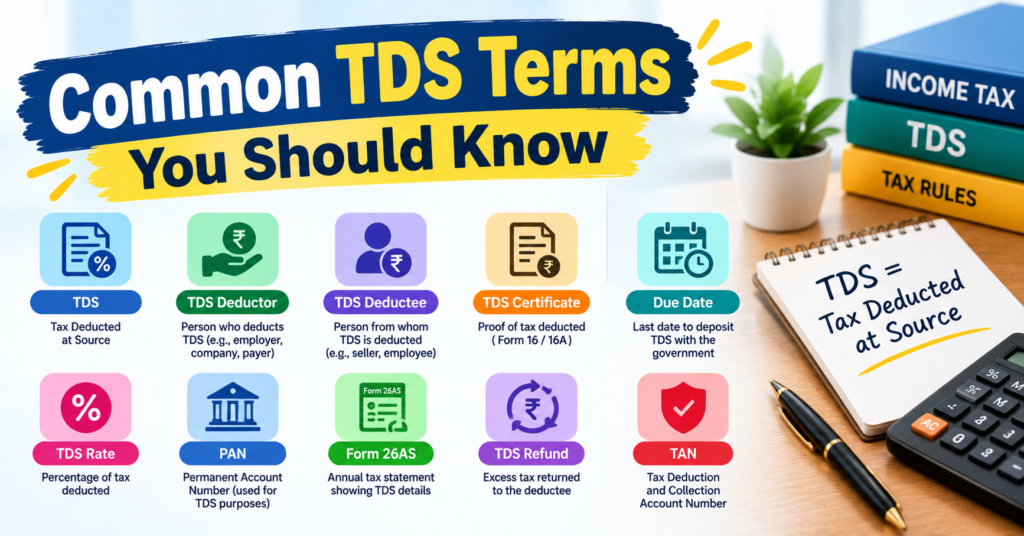
Common TDS Terms You Should Know
- TAN (Tax Deduction Account Number) — a unique number every deductor must obtain before deducting TDS
- PAN (Permanent Account Number) — used to track TDS credit for each taxpayer
- Form 26AS/AIS — a consolidated tax statement showing all TDS credited to your PAN
- TDS Return — a quarterly statement (Form 24Q for salary, Form 26Q for other payments) filed by the deductor
- TCS (Tax Collected at Source) — a related but separate mechanism where tax is collected by the seller at the point of sale
- Section 206AA — mandates a higher TDS rate (usually 20%) if the deductee doesn’t furnish PAN
- TDS Refund — the excess TDS amount returned to the taxpayer after filing an ITR, if actual tax liability is lower
Conclusion
TDS is essentially a pay-as-you-earn system built into everyday transactions — salary, rent, interest, and professional payments. Understanding how it works, checking your Form 26AS regularly, and keeping your TDS certificates organized makes tax filing far smoother and helps you avoid unnecessary penalties or missed refunds.Staying informed about current TDS rates and thresholds each financial year is the simplest way to stay compliant and in control of your finances.
Frequently Asked Questions About TDS
What is the full form of TDS?
TDS stands for Tax Deducted at Source, a system where tax is deducted at the time a payment is made.
Who is responsible for deducting TDS?
The deductor — such as an employer, bank, tenant, or business making the payment — is responsible for deducting and depositing TDS.
Can I get a refund if excess TDS is deducted?
Yes, if the TDS deducted exceeds your actual tax liability, you can claim a refund while filing your Income Tax Return.
What happens if TDS is deducted but not deposited?
The deductor becomes liable for interest, penalties, and possible disallowance of the related expense under the Income Tax Act.
Is TDS applicable to all types of income?
No, TDS applies only to specified payments like salary, rent, interest, and professional fees once they cross a prescribed threshold.
How can I avoid TDS on bank interest?
If your total income is below the taxable limit, you can submit Form 15G or Form 15H to your bank to avoid TDS deduction.
What is the difference between TDS and income tax?
TDS is deducted in advance by the payer at the time of payment, while income tax is calculated and paid by the taxpayer based on total annual income.
