

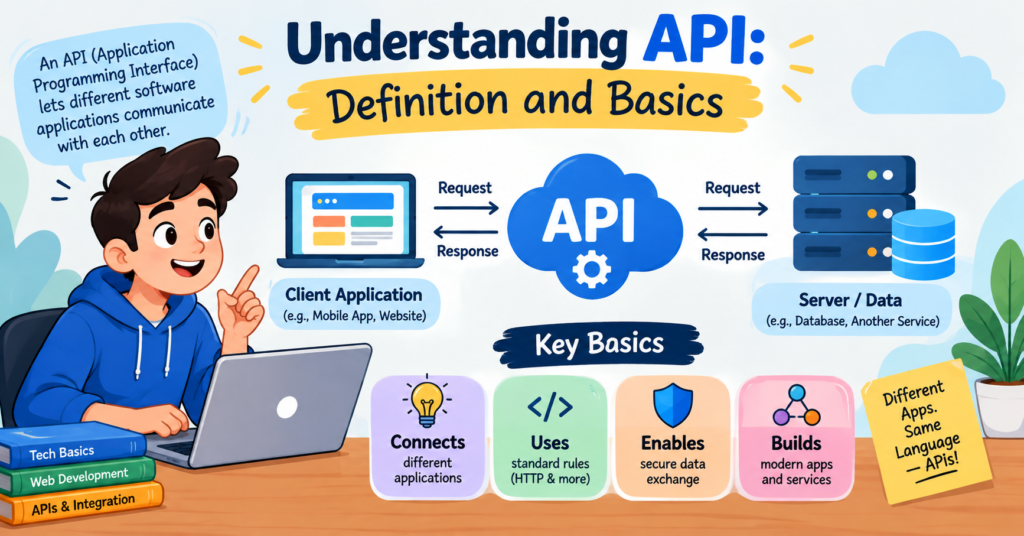
Have you ever wondered how apps talk to each other? The answer is often an API. API stands for Application Programming Interface. It’s a set of rules that lets two software programs communicate. Think of an API like a messenger between apps. One app sends a request, and the API delivers it to another app. That app sends back a response through the same API. This happens behind the scenes every time you use most apps. APIs power a huge part of the technology we use daily. Weather apps, payment systems, and social media logins all rely on them. Without APIs, apps would have a much harder time sharing data. This guide breaks down what APIs really mean and how they work.
APIs act as a bridge between systems. They define exactly what requests are allowed, what data can be exchanged, and how the two systems should “talk” to each other. This standardization is what makes modern software so interconnected
An API works through a simple request-and-response process. One application asks for something, and the API handles the exchange between systems behind the scenes.
Here’s how the process generally unfolds:
- RequestAn application (called the client) sends a request through the API, asking for specific data or an action.
- Processing The API forwards that request to the server or software system that holds the information.
- Response The server processes the request and sends the requested data back through the API.
- Delivery The API delivers that response to the original application, which then displays or uses the data.
Types of APIs Explained
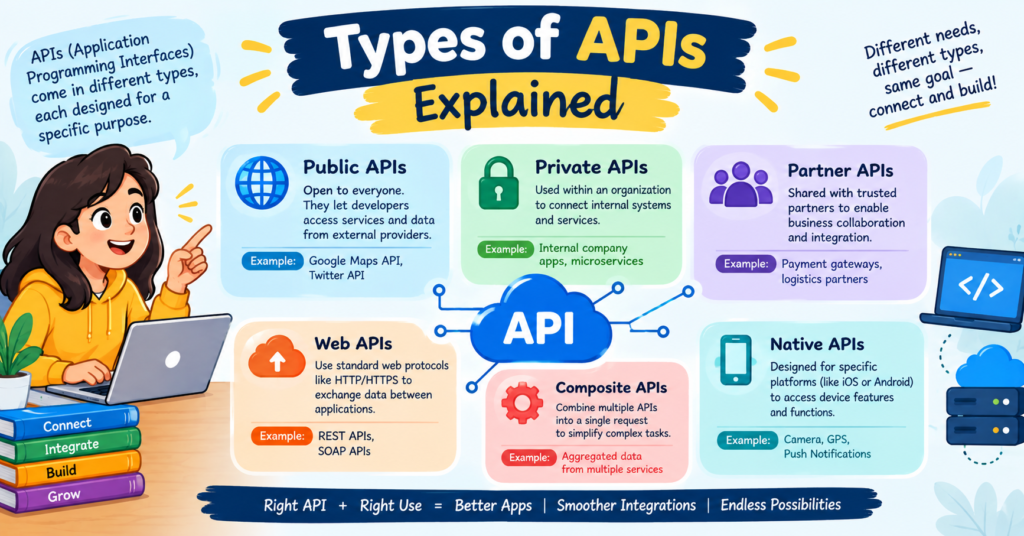
Not all APIs work the same way. They can be categorized based on who can access them and the protocol they use.
By Access Level:
- Open APIs (Public APIs): Available to any developer, often with minimal restrictions
- Partner APIs: Shared only with specific, approved business partners
- Composite APIs: Combine multiple API calls into a single request for efficiency
By Architecture/Protocol:
| API Type | Description | Common Use Case |
|---|---|---|
| REST | Uses standard HTTP methods; lightweight and widely used | Web and mobile apps |
| SOAP | A stricter, XML-based protocol with built-in security | Banking and enterprise systems |
| GraphQL | Lets clients request exactly the data they need | Apps needing flexible data queries |
| WebSocket | Enables real-time, two-way communication | Live chats, gaming, stock tickers |
REST APIs are by far the most common choice for modern web and mobile development, mainly because they’re simple, flexible, and easy to scale.
API vs. SDK: What’s the Difference?
People often confuse APIs with SDKs, but they serve different purposes. Understanding the difference helps clarify how software tools fit together.
| Feature | API | SDK |
|---|---|---|
| Full Form | Application Programming Interface | Software Development Kit |
| What It Is | A set of rules for communication between systems | A complete toolkit for building applications |
| Contains | Endpoints and data exchange rules | APIs, libraries, documentation, and tools |
| Purpose | Lets software components talk to each other | Helps developers build software faster |
In short, an API is a single communication tool, while an SDK is a full package that often includes one or more APIs along with extra resources like code samples and debugging tools. An SDK could not function properly without APIs, but an API can exist on its own.
Common Examples of APIs in Everyday Apps
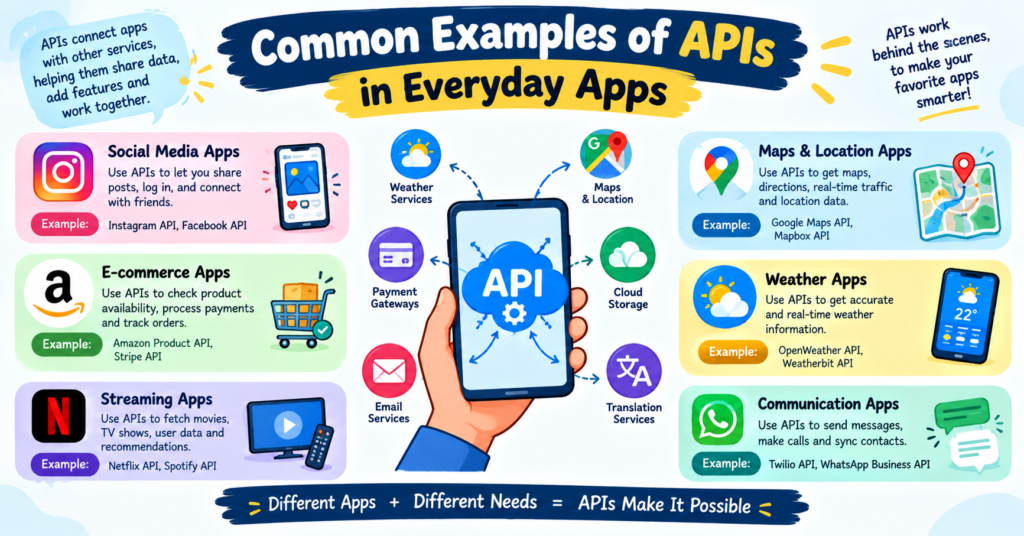
APIs are everywhere, even if you never see them directly. Here are some everyday examples most people interact with regularly.
- Weather apps – Pull real-time forecast data from weather service APIs
- Social media logins – “Sign in with Google” or “Sign in with Facebook” buttons use APIs to verify identity
- Payment gateways – Apps like PayPal or Stripe use APIs to process transactions securely
- Maps and navigation – Apps use mapping APIs (like Google Maps) to show routes and locations
- Travel booking sites – Pull flight prices and hotel availability from airline and hotel APIs
- Ride-sharing apps Use APIs to track driver location and calculate fares in real time
Each of these examples shows the same basic idea: one app requesting data from another system, without needing to build that entire system itself.
Why Are APIs Important for Businesses and Developers?
APIs play a major role in how modern software gets built, scaled, and connected. Their importance goes beyond just convenience.
For developers, APIs offer:
- Faster development No need to build every feature from scratch
- Access to specialized services Payment processing, mapping, and AI tools are all available through APIs
- Easier integration Multiple systems can work together smoothly
- Better scalability Applications can grow and add features more easily
For businesses, APIs offer:
- New revenue streams Companies can sell access to their own APIs
- Wider reach Other developers can build on top of a company’s platform
- Improved efficiency Internal APIs help different departments’ systems communicate
- Stronger partnerships APIs make it easier to integrate with other businesses’ tools
This is exactly why so many modern companies, from tech giants to small startups, treat their APIs as a core part of their product strategy rather than just a technical detail.
Frequently Asked Questions About API
What does API stand for?
API stands for Application Programming Interface, a set of rules that lets different software applications communicate with each other.
How does an API work in simple terms?
An API works by taking a request from one application, passing it to another system, and returning a response with the requested data.
What is the most common type of API?
REST APIs are the most commonly used type today because they’re lightweight, flexible, and easy to work with.
What is the difference between an API and an SDK?
An API is a communication tool between software systems, while an SDK is a full toolkit that often includes APIs plus extra development resources.
Can you give an example of an API in daily life?
Yes, Sign in with Google buttons, weather apps, and ride-sharing apps all use APIs to pull or share data between systems.
Do I need to know coding to use an API?
Basic API use, like using an app that relies on one, requires no coding. Building or integrating with an API directly usually requires programming knowledge.
Conclusion
API stands for Application Programming Interface, and it’s one of the most important building blocks of modern software. APIs let different applications share data and work together smoothly, powering everything from weather apps to payment systems. Understanding how APIs work, the different types available, and how they differ from SDKs gives you a clearer picture of the technology running quietly behind almost every app you use.
