

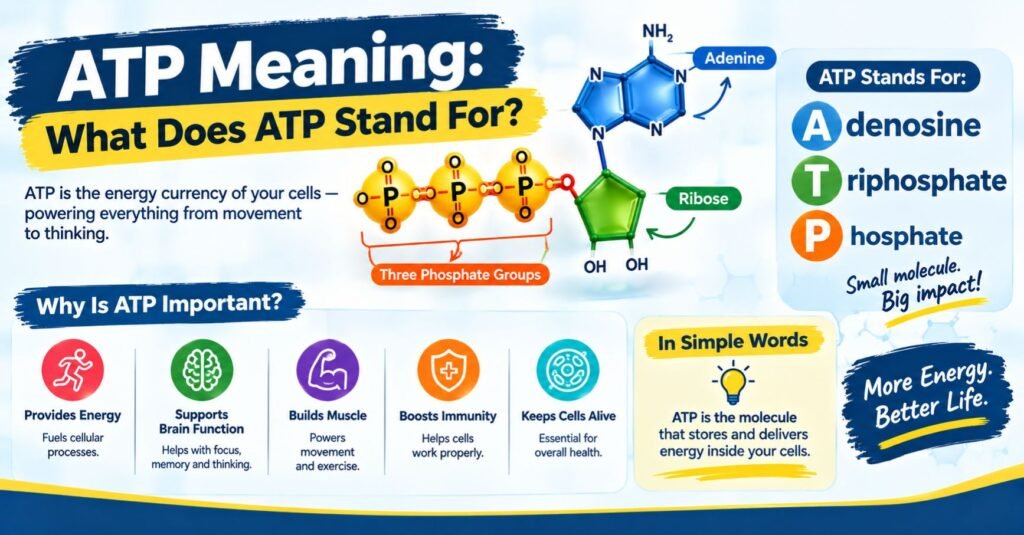
Have you ever come across ATP in a biology class or a science article? It’s a term used a lot in living things. ATP stands for Adenosine Triphosphate. It’s a small molecule, but it plays a huge role in the body. Every cell in your body needs energy to work. ATP is the main source of that energy. It’s often called the “energy currency” of the cell. Without it, cells couldn’t move, grow, or repair themselves. ATP is made from three simple parts joined together. These parts store energy that cells can use anytime. When a cell needs power, it breaks down ATP to release it. This guide explains ATP’s meaning in simple, easy words.
What Does ATP Stand For in Biology?
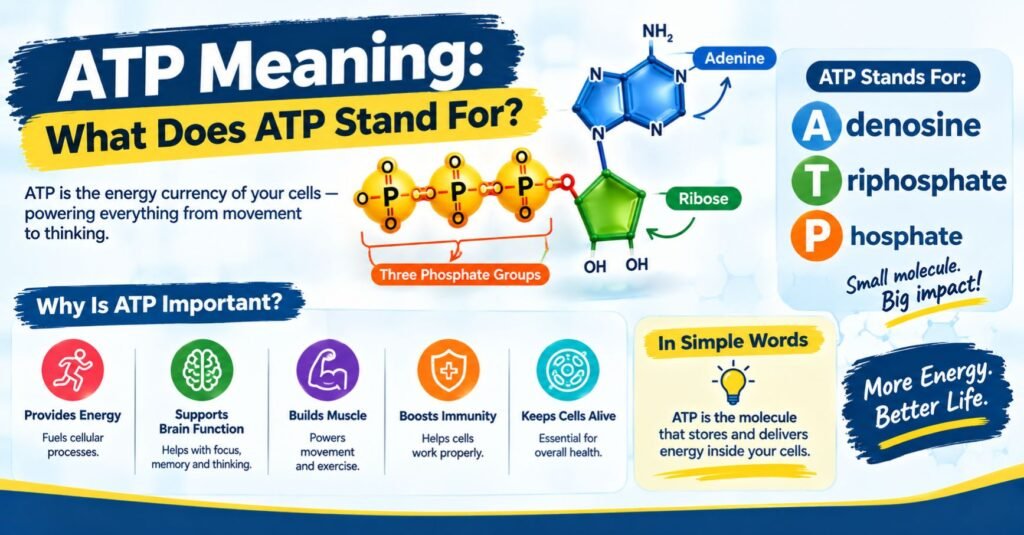
In biology, ATP stands for Adenosine Triphosphate. It’s a molecule found in every living cell, from bacteria to human muscle cells. Its main job is to store energy and release it whenever the cell needs to do work.
The molecule is made of three basic parts:
- Adenine – a nitrogen-based building block
- Ribose – a five-carbon sugar
- Three phosphate groups – linked together in a chain
The three phosphate groups are what make ATP special. The bond holding the last phosphate group carries a lot of chemical energy. When that bond breaks, the stored energy gets released and the cell puts it to use right away.
How Does ATP Provide Energy to Cells?
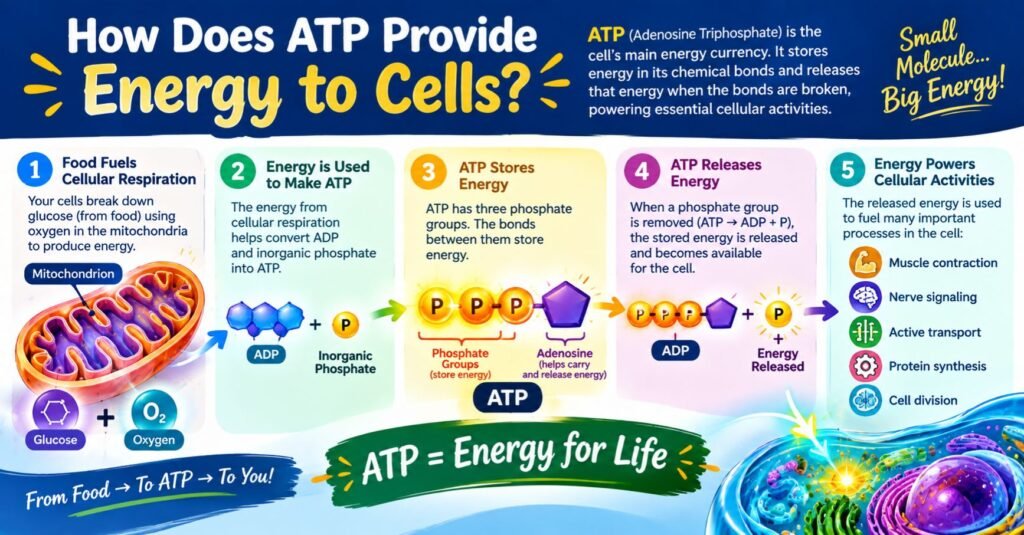
ATP releases energy through a chemical reaction called hydrolysis. This process uses water to break the bond between the second and third phosphate groups, and that break is what sets the energy free.
Here’s how the process usually plays out:
- ATP loses one phosphate group and becomes ADP (Adenosine Diphosphate).
- Energy is released during this step, and the cell uses it right away.
- The cell later adds a phosphate group back, rebuilding ATP from ADP.
- This cycle repeats nonstop, thousands of times inside every active cell.
A simple way to picture it: ATP works like a rechargeable battery. It powers a task, drains down to ADP, and gets recharged so it can be used again and again.
How Is ATP Made in the Body?
Most of the body’s ATP is produced inside a cell structure called the mitochondria, often called the “powerhouse of the cell.” ATP production happens in three connected stages.
| Stage | Where It Happens | What It Does |
|---|---|---|
| Glycolysis | Cell cytoplasm | Breaks glucose into smaller molecules |
| Krebs Cycle | Mitochondria | Pulls more energy out of those molecules |
| Oxidative Phosphorylation | Mitochondria | Generates the majority of the cell’s ATP |
Cells that need a lot of energy, like muscle and heart cells, contain more mitochondria than other cells. That’s exactly why these tissues can keep producing large amounts of ATP throughout the day.
ATP vs. ADP: What’s the Difference?
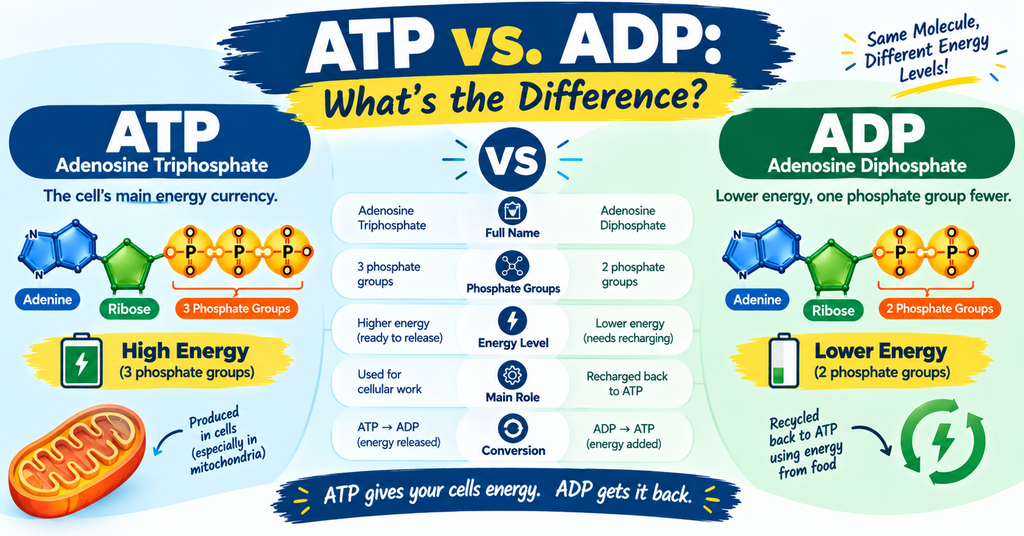
ATP and ADP are closely linked, and understanding how they relate makes the whole topic much easier to follow.
| Feature | ATP | ADP |
|---|---|---|
| Full Form | Adenosine Triphosphate | Adenosine Diphosphate |
| Phosphate Groups | 3 | 2 |
| Energy Level | High energy | Lower energy |
| Role in the Cell | Stores and delivers energy | Left over after energy is released |
In short, ATP turns into ADP once it releases its energy, and ADP turns back into ATP once it picks up another phosphate group. The two molecules constantly convert back and forth to keep the cell’s energy supply running.
Why Is ATP Important?
ATP isn’t just a background chemical . it powers almost everything a cell does. Here are some of its most important roles:
- Muscle contraction . muscles rely on ATP to move and stay active
- Protein synthesis . building new proteins takes a steady supply of ATP
- Nerve signaling . nerve cells use ATP to send messages throughout the body
- Cell division . ATP fuels the process of cells splitting and multiplying
- Active transport . moving substances across cell membranes often depends on ATP
Because ATP touches so many processes, even a small drop in ATP production can affect energy levels, muscle strength, and overall cell health.
Other Common Meanings of ATP
Adenosine Triphosphate is the most well-known meaning, but ATP shows up as a shorthand in a few other areas too. Here are the most common ones people run into:
- Association of Tennis Professionals (ATP) the organization behind men’s professional tennis, known for the ATP Tour and ATP rankings
- At This Point (ATP) casual texting shorthand, similar to saying “at this stage”
- Available to Promise (ATP) a business and supply-chain term used in inventory planning
- Automatic Train Protection (ATP) a railway safety system that helps control train speed
If “ATP” shows up outside a science context, checking the surrounding sentence usually points you toward sports, business, or casual texting instead.
Frequently Asked Questions About ATP
What does ATP stand for?
ATP stands for Adenosine Triphosphate, a molecule that stores and releases energy inside living cells.
What is the main function of ATP?
ATP’s main function is to supply energy for cellular processes like muscle movement, protein building, and nerve signaling.
Where does the body produce ATP?
The body produces most of its ATP inside the mitochondria, through a process called oxidative phosphorylation.
What is the difference between ATP and ADP?
ATP has three phosphate groups and holds more energy, while ADP has two phosphate groups after that energy has been used.
Does ATP have any other meanings?
Yes, ATP can also stand for Association of Tennis Professionals, At This Point, or Available to Promise, depending on the context.
Why is ATP called the “energy currency” of the cell?
It’s called this because ATP constantly moves energy to wherever the cell needs it, much like currency gets exchanged for goods.
Conclusion
ATP, or Adenosine Triphosphate, is the molecule that keeps every living cell powered and running. From muscle movement to protein building, almost every process in the body depends on a steady supply of ATP. Understanding how it’s made, how it works with ADP, and why it matters gives you a clearer picture of how your own cells produce and use energy every single day.
