

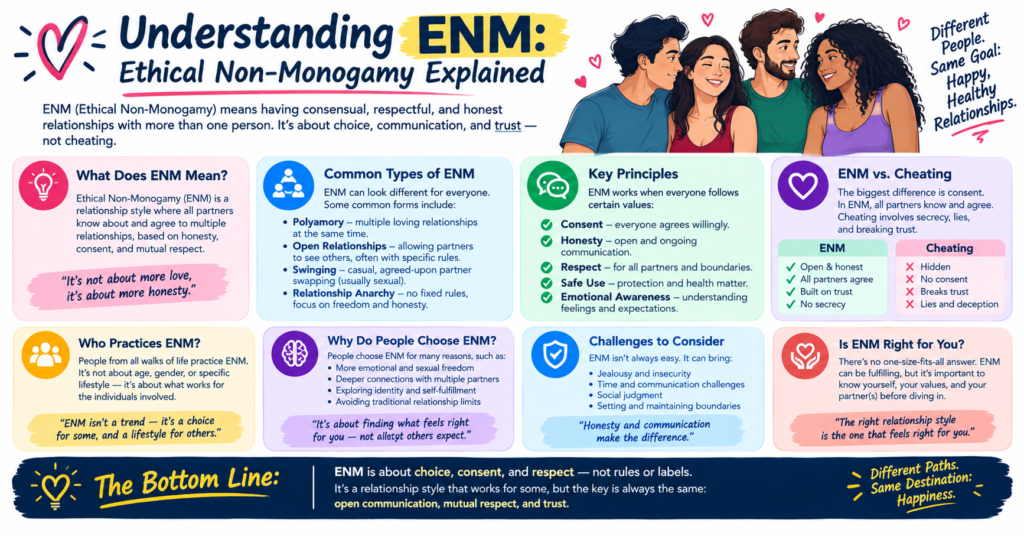
Have you heard the term “ENM” and wondered what it really means? ENM stands for Ethical Non Monogamy. It describes relationships where people can have more than one partner. Everyone involved knows about it and agrees to it. ENM is built on honesty and open communication. Partners talk openly about their feelings and boundaries. Nobody is kept in the dark or lied to. This honesty is what makes it “ethical” instead of just casual dating. There are many different types of ENM relationships. Some people practice polyamory, while others prefer open relationships. Each type has its own rules and structure. This guide will help you understand the basics clearly.
What Does ENM Stand For?
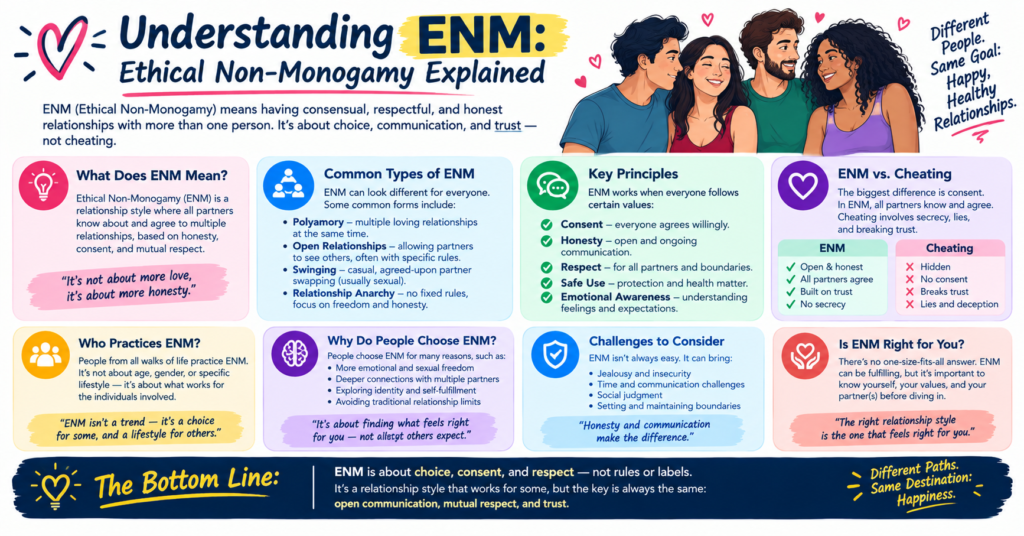
ENM stands for Ethical Non-Monogamy. It’s an umbrella term for any relationship where partners agree to form romantic or sexual connections with more than one person at the same time. The word “ethical” is the most important part of the term. It points to full honesty and consent between everyone involved. Without that consent, the same behavior would simply be considered cheating, not ENM. You might also see the term “CNM,” which stands for Consensual Non-Monogamy. Many people use ENM and CNM interchangeably, though ENM tends to place slightly more emphasis on respectful, thoughtful practice rather than just agreement.
Key traits that define ENM include:
- Full knowledge and consent from everyone in the relationship
- Open communication about feelings, needs, and boundaries
- Respect for each partner’s autonomy and choices
- Honesty as an ongoing practice, not a one-time conversation
ENM vs Polyamory What’s the Difference?
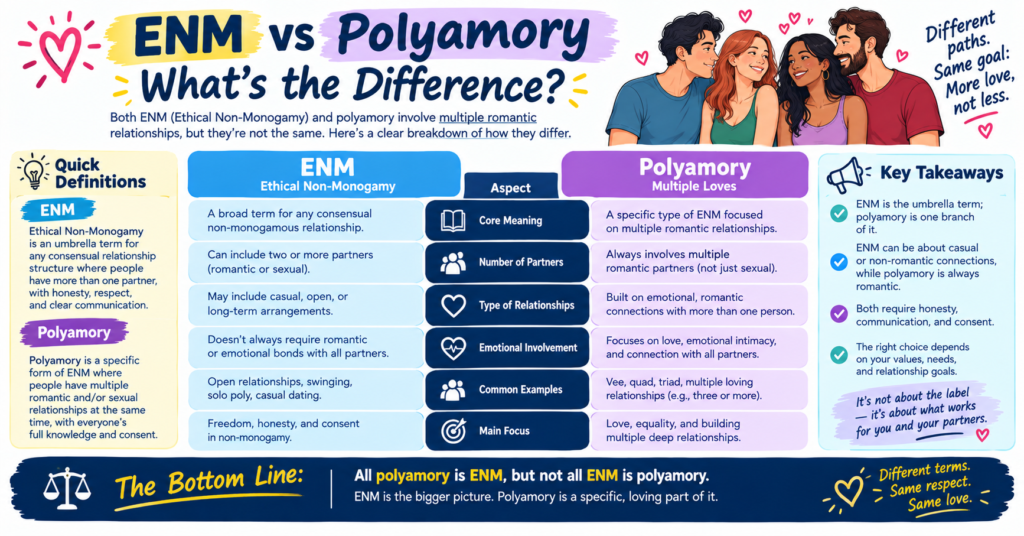
A lot of people use “ENM” and “polyamory” as if they mean the same thing, but they don’t line up exactly. Understanding the difference makes both terms easier to use correctly. ENM is the broader umbrella term. It covers any consensual relationship structure outside of monogamy, no matter what form it takes. Polyamory is one specific type of ENM, focused on having multiple romantic relationships rather than purely physical ones.
| Term | Definition | Scope |
|---|---|---|
| ENM | Umbrella term for any consensual non-monogamous relationship | Broad, includes many structures |
| Polyamory | Having multiple romantic relationships with everyone’s consent | Narrower, one type of ENM |
| Open Relationship | A couple allows outside sexual connections | Narrower, one type of ENM |
| Swinging | Couples engage in recreational sex with others, often as couples | Narrower, one type of ENM |
In short, every polyamorous relationship is a form of ENM, but not every ENM relationship is polyamorous. Some ENM relationships are purely physical, while polyamory usually involves emotional connection and commitment to multiple partners.
Common Types of Ethical Non Monogamy
ENM isn’t one single relationship style. It’s a category that includes several different structures, each with its own approach to intimacy and commitment.
- Polyamory Having multiple romantic relationships at the same time, with everyone’s knowledge and consent.
- Open Relationships A primary couple agrees that one or both partners can have sexual relationships with others.
- Swinging Couples engage in recreational sexual activity with other couples or individuals, often through events or communities.
- Monogamish A relationship that’s mostly monogamous but allows occasional outside sexual activity.
- Relationship Anarchy Rejects traditional rules and hierarchies, letting each relationship define its own structure without a set template.
- Polyfidelity A closed group of people, often three or more, who commit exclusively to each other with no outside partners.
Each style fits different needs. Some people want emotional variety, while others are more focused on physical exploration. There’s no single “correct” way to practice ENM only the structure that fits the people involved.
Core Principles of ENM (Consent, Honesty, Communication)
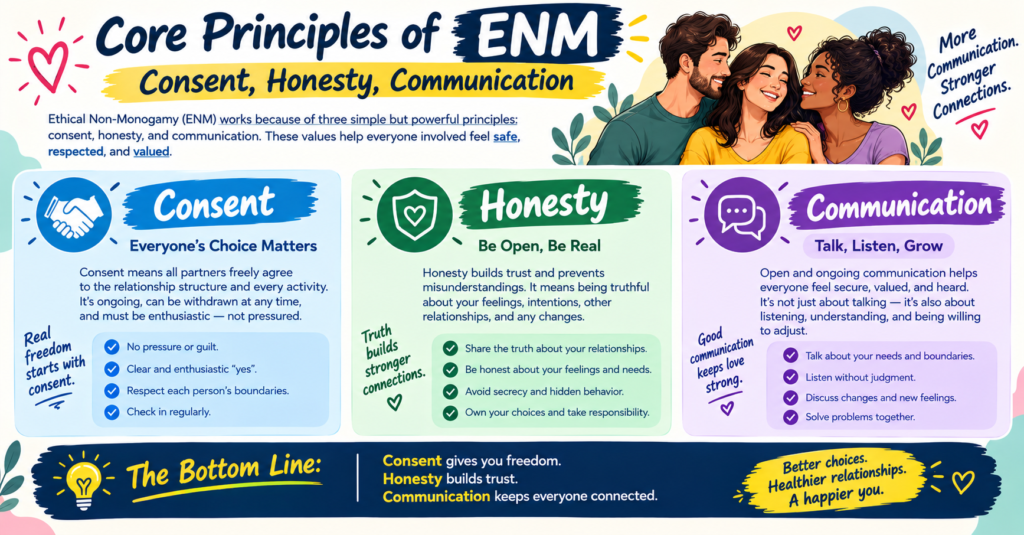
Every successful ENM relationship rests on a few shared principles. Without these, the structure tends to break down quickly, regardless of which type of ENM is being practiced.
- Consent: Every person involved understands the relationship structure and agrees to it willingly. Consent isn’t a one-time checkbox it’s revisited as needs and feelings change.
- Honesty: Partners are truthful about their other relationships, feelings, and intentions. Hiding a connection from a partner isn’t ENM; it’s deception.
- Communication: Regular, open conversations about boundaries, jealousy, and expectations keep everyone on the same page.
- Respect: Each partner’s autonomy is respected, including their right to say no or set limits.
- Boundaries: Clear limits are discussed in advance, whether that’s about safe sex practices, time spent with other partners, or what information gets shared.
Jealousy still shows up in ENM relationships, just like it does in monogamous ones. The difference is that ENM relationships tend to treat jealousy as something to talk through openly, rather than something to avoid discussing.
Common Misconceptions About ENM
Because ENM isn’t as widely understood as traditional monogamy, several myths tend to follow it around. Clearing these up helps separate fact from assumption.
- Myth: ENM is just a excuse to cheat. Cheating involves deception, while ENM is built entirely on transparency and mutual agreement. The two are fundamentally different.
- Myth: ENM is only about sex. Many ENM relationships include deep romantic and emotional connections, not just physical ones. Polyamory in particular often centers on love and long-term commitment.
- Myth: People choose ENM because they can’t commit. ENM requires ongoing commitment to communication, honesty, and multiple relationships at once arguably more effort than a single monogamous bond.
- Myth: Jealousy doesn’t exist in ENM relationships. Jealousy is a normal human emotion. ENM doesn’t remove it; it simply focuses on healthy ways to process and discuss it.
- Myth: ENM is a new trend. Non-monogamous relationship structures have existed across many cultures throughout history. The term “ENM” is relatively recent, but the underlying practice isn’t.
Is ENM Right for You? Key Things to Consider
ENM isn’t the right fit for everyone, and that’s completely normal. Before exploring it, it helps to reflect honestly on a few key questions.
- Can you communicate openly about difficult emotions? ENM relies heavily on discussing feelings like jealousy, insecurity, and desire without shutting down.
- Are you comfortable with your partner having other connections? This includes both emotional and physical intimacy with others.
- Do you have the time and energy for multiple relationships? Managing schedules, emotional needs, and communication across partners takes real effort.
- Are you doing this for yourself, or to please someone else? ENM works best when it’s a genuine personal choice, not pressure from a partner.
If ENM doesn’t feel right after honest reflection, that’s not a failure monogamy simply works better for many people. The goal is finding the structure that fits your own values and needs, not following a trend.
History and Growing Popularity of ENM
Non-monogamous relationships aren’t a modern invention. Historical and anthropological records show that various cultures have practiced forms of multiple-partner relationships for centuries, long before the term ENM existed. The specific language around ENM developed more recently, growing alongside broader conversations about relationship diversity from the late 20th century onward. As therapists, researchers, and online communities began discussing consensual non-monogamy more openly, terms like ENM and CNM became more common in everyday conversation. Interest in ENM has grown noticeably in recent years. Surveys suggest a small but meaningful percentage of relationships today are consensually non-monogamous, and dating apps now regularly include options for open or polyamorous relationship statuses. Greater visibility in media, therapy, and online discussion has helped normalize ENM as one valid relationship structure among many, rather than something rare or hidden.
Frequently Asked Questions
What does ENM mean?
ENM stands for Ethical Non-Monogamy, a relationship style where partners consensually connect with more than one person at a time.
Is ENM the same as polyamory?
No. ENM is the broader umbrella term, while polyamory is one specific type of ENM focused on multiple romantic relationships.
Is ENM the same as cheating?
No. Cheating involves deception, while ENM is based on full honesty and consent from everyone involved.
What are the main types of ENM?
Common types include polyamory, open relationships, swinging, monogamish relationships, relationship anarchy, and polyfidelity.
Does jealousy still happen in ENM relationships?
Yes. Jealousy is a normal emotion, and ENM relationships focus on communicating through it rather than eliminating it entirely.
Conclusion
ENM, or Ethical Non-Monogamy, is an umbrella term for relationships where multiple partners are involved with full honesty and consent. It includes several distinct styles, from polyamory to open relationships, each shaped by communication, respect, and clear boundaries. Understanding what ENM actually means and how it differs from terms like polyamory makes it easier to see it as one legitimate relationship structure among many, built on the same core values that make any relationship work: trust, honesty, and mutual respect.
